

The latest Canada-China Brief offers exclusive insight into major developments shaping the bilateral relationship:
Head-to-head: Track the latest developments, from renewed high-level meetings to growing scrutiny from Washington over CUSMA’s future
Data Dive: See the key numbers, charts, and analysis behind changing global attitudes and the Chief Economist of Global Affairs Canada’s yearly trade rundown
Expert voices: New analysis from experts in both Canada and China sheds light on Canada’s hedging strategy between the U.S. and China
Data Dive
The takeaways:
Canadian favourability toward China has rebounded to pre–’Two Michaels’ levels, reaching 44% for the first time since 2018, now exceeding favourability toward the United States (33%).
Canadians express greater confidence in Xi Jinping (35%) than Donald Trump (20%) to do the “right thing in international affairs.” Confidence in Xi is comparable to the U.K. and higher than in Germany, Australia, and Japan.
This shift has occurred despite persistent concerns about China’s human rights record, with 86% of Canadians saying the Chinese government does not respect the personal freedoms of its citizens.
What’s next below the paywall:
A look at the latest reporting from Global Affairs Canada on the largest growth drivers of Canada’s exports to China and around the world
Data from the foreign ministry’s Chief Economist looking at how Canada-China trade growth offset global declines elsewhere
Wang Yong: Professor, School of International Studies and Director, Center for American Studies, Peking University
Zhao Xingshu: Senior Fellow, Institute of American Studies, Chinese Academy of Social Sciences
Xiong Feng: Chief Analyst, International Relations and Policy, Huafu Securities
IPD highlights the numbers that matter. Access more data analysis below the paywall by subscribing now for just $5/month.
Top Story
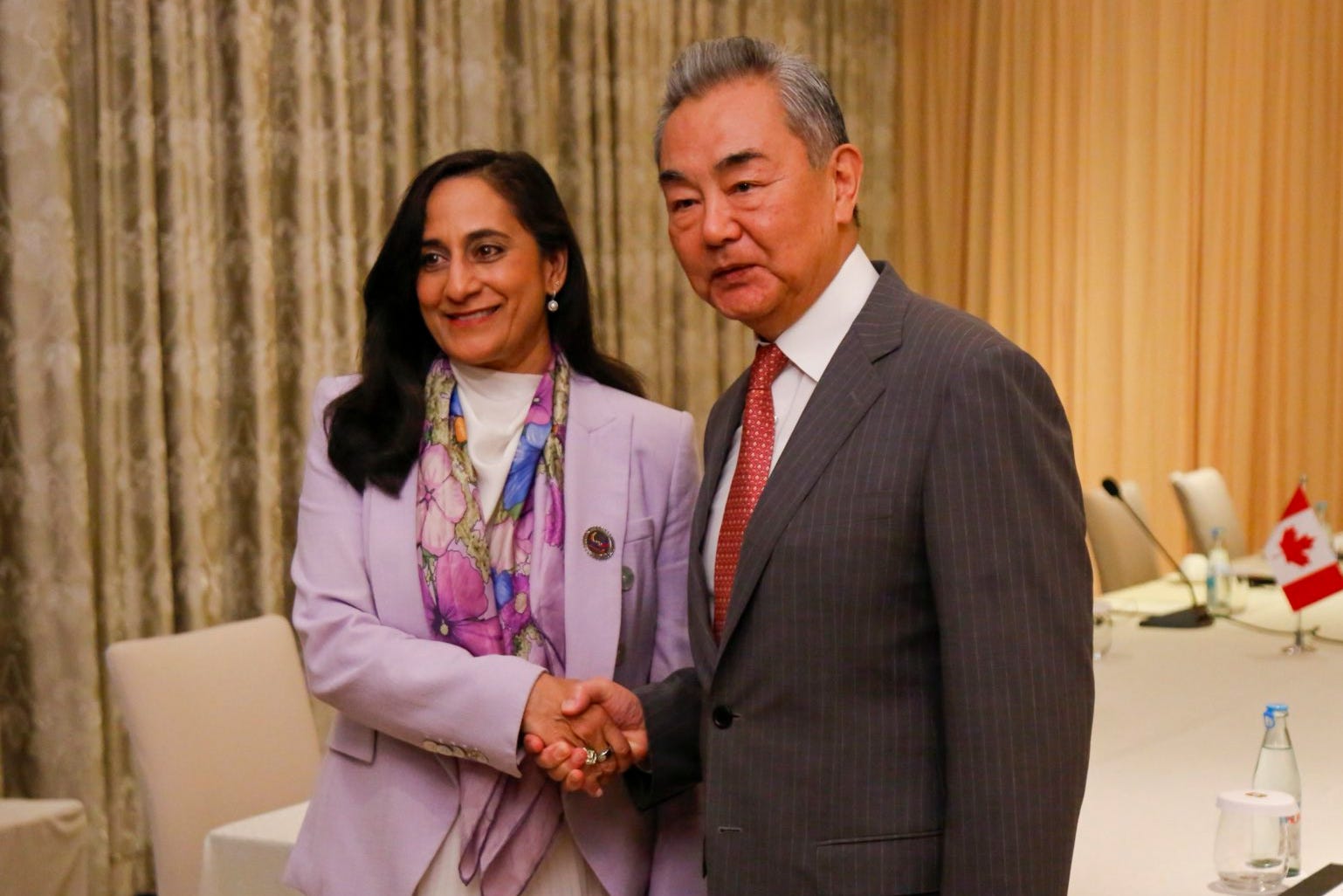
In Manila, Anand and Wang Talk ‘New-Type’ Relations
Trade and trouble — A wave of high-level meetings underscores growing diplomatic momentum as Ottawa faces new Trump tariffs and CUSMA’s review:
Meeting in Manila, Foreign Affairs Minister Anand and Chinese Foreign Minister Wang Yi reaffirmed their commitment to the Canada-China Strategic Partnership signed in January, with Wang describing it as the “right historical choice” while using a relatively recent term to call it a “new-type strategic partnership.”
Anand also highlighted advancing the Strategic Partnership, discussing “areas where further progress could support Canadian workers and businesses,” adding they also “exchanged views on regional and global security concerns,” with the Chinese readout noting this included multilateral issues such as AI governance.
Both agreed to intensify cooperation on “energy, trade, finance, and counter-narcotics” as Anand raised concern about the Indo-Pacific’s “broader geopolitical situation,” calling China-Philippine maritime tensions “troubling” and comparing how the South China Sea and Strait of Hormuz required freedom of navigation.
Separately, Senior Advisor to the PM David Morrison and Deputy Foreign Minister Arun Thangaraj travelled to Beijing to meet Vice Minister Lu Kang of the CPC’s International Department, striking a similarly positive tone as Kang stated that “relations have improved and are widely welcomed by all sectors.”
Hong Kong media and author sources speculate that Anand’s meeting with Wang prepared ground for President Xi Jinping to potentially stop in Canada during his September visit to the U.S. — one that, if confirmed, would mark the first visit by a Chinese head of state to Canada in 16 years.
Meanwhile in Washington — American officials increasingly frame Canada-China ties as a threat to the U.S. as the White House has enacted new tariffs on Ottawa:
Testifying on President Trump’s trade and tariff policy before the Senate, U.S. Special Trade Representative Jamieson Greer claimed that Canada would only have higher tariffs than China “on a small handful” of products and that American tariffs on China were “by far much higher than Canada overall.”
Greer later told CNBC that “no one has retaliated against us except China and Canada, so we’re taking a targeted measure to counter that retaliation,” adding that U.S. policies see “production lines come from Canada back to the U.S. We’re seeing Toyota and others move from Mexico to the U.S. That’s what we want.”
He went on to say that “if you’re planning on building a new factory in Canada and exporting back to the United States, I think you have to understand that the American people, they don’t want offshoring. This is a bipartisan view. We don’t want a situation where those jobs are going north.”
Congresswoman Claudia Tenney recently warned that “Canada has allowed China to slip in. We want to make sure there’s absolute security so that China does not exploit USMCA and their ability to deal with Canada slips those products into our country and take advantage of them.”
An era of ‘geo-industrialization’ — Ottawa has grown to embrace the importance of diplomacy with China as a means of politically managing the economy:
Addressing Chatham House, Industry Minister Mélanie Joly stated that “industrial policy is the new geopolitics. We’ve entered an era of geoindustrialization where doing business together is no longer through only private markets. It is also very much through government-to-government decisions.”
She elaborated that “these decisions are linked to geopolitical choices,” which means working with the U.S. and China but “fundamentally also being able as a middle power to draw our own path and being able with sizable economies to work together to keep markets open to attract capital and to create jobs.”
This outlook is reflected in a recently-disclosed briefing binder for the Deputy Minister of Finance Nick Leswick, which explicitly notes that the January tariff deal with China “is intended to catalyse new Chinese joint-venture investment in Canada with trusted partners to protect and create new auto manufacturing jobs.”
Minister Anand, who is in the midst of revising Canada’s Indo-Pacific Strategy, also stated in a recent interview that Ottawa’s approach now is “a foreign policy that is responding to a completely rewired global trading order, and our work to double non-U.S. trade over the next 10 years.”
From the Experts
IPD brings what scholars and opinion leaders in China and Canada have to say on the challenges both countries face.
The Word in Canada

Carlo Dade
Director, International Policy and Head, New North America Initiative, School of Public Policy, University of Calgary | READ
As the [U.S.] administration is fond of reminding Canadians when they visit D.C. — and as Monday’s White House factsheet states — only two countries have dared to impose retaliatory tariffs on the U.S., and both countries begin with a “C.” The Americans have fewer levers to retaliate against China, and what they have done has not worked. Canada, on the other hand, isn’t China. […]
Canada cannot control what Washington does. It can, theoretically, control or influence the Canadian response. But it can only do so if it is prepared and proactive.
The two — prepared and proactive — of course go hand in hand. This is the challenge facing Canada going forward. Having the capacity to anticipate American actions is a major, missing part of what will be required in managing a relationship with the Americans that we can neither avoid nor flee. This will require more resources, more research, more preparation, and require it on an ongoing basis. Once the Pandora’s Box of a tariff war is cracked open, it is not easily shut.

James Rowland
President, Clear Arrow; Former Director, International Government Affairs, Ford Motor Company | READ
The success of China’s auto industry, and the pace at which it has scaled exports, presents a historic competitive challenge to global auto manufacturing and to the U.S. position, in particular. Mexican and Canadian auto production is deeply integrated with U.S. manufacturing, which is why China has become such a focal point in the USMCA review. […]
When China opened its automotive market to Western automakers, it faced a policy inflection: how to open up while protecting the market for domestic industry. Its answer was high investment thresholds, mandatory joint venture partners, tariffs around 25%, and value-added taxes. That structure protected China’s market while its indigenous industry developed.
North America faces the same kind of inflection point today. USMCA is a central part of the strategy to answer it, and the broader industrial policy conversation, including how to curb Chinese imports, has to be built around it. Including Mexico and Canada in that conversation is critical to preserving the competitiveness of the North American auto sector.
The Word in China

Ma Xue
Associate Fellow, Institute of American Studies, China Institutes of Contemporary International Relations | READ
Any significant divergence from Washington’s China-related trade and economic control standards would directly jeopardize the ongoing USMCA review and renewal process. As a result, both [Canada and Mexico] are likely to find themselves under growing pressure to accommodate the economic security agenda of the United States.
This underlying tension ultimately defines the policy boundaries of the current USMCA review. None of the parties appears intent on erecting a comprehensive trade barrier that would sever economic ties with China. Instead, the anticipated regulatory adjustments are likely to follow a targeted and selective approach, imposing differentiated market access requirements in five sensitive areas: automobiles and parts, the power battery supply chain, strategically critical minerals, next-generation telecommunications infrastructure and foreign investments with national security implications.
The objective is to narrow the scope of China’s industrial presence in North America through calibrated regulatory controls, not to bring China-North America economic and trade relations to a halt.

Wang Yong
Professor, School of International Studies and Director, Center for American Studies, Peking University | READ
Canada’s economy has long been heavily dependent on the U.S. market, with close ties between the two countries in automobiles, energy, agricultural products, and manufacturing. Canada was willing to accept this dependence in the past because there were relatively stable institutional arrangements between the two sides. But now, with the U.S. able to unilaterally impose tariffs and even bypass existing agreements, Canada must reconsider: is the risk of putting its main market and supply chain all on the U.S. already too high? [...]
However, a full-scale Canadian countermeasure against the U.S. is not easy. The U.S. market is large, and the industries of both sides are deeply integrated. If Canada imposes large-scale retaliatory tariffs, its own businesses and consumers will also bear the costs. Therefore, Canada must continue negotiations with the U.S. on one hand, while also seeking new markets and partners on the other to reduce its dependence on the U.S. market.
This is the real-world background of the China-Canada foreign ministers’ meeting. China is a major global consumer market and an important potential buyer of Canadian agricultural products, energy, and resource products. For Canada, developing relations with China does not mean distancing itself from the U.S., but rather reducing single-market risk. The greater the U.S. tariff pressure, the stronger Canada’s incentive to promote market diversification.
See more in translation under the paywall.
Thanks for reading the Canada-China Brief from the Institute for Peace & Diplomacy! Subscribe now for just $5/month for full access to Data Dive and The Word in China coverage below, including extended analysis and translated expert commentary