

The latest Canada-China Brief offers exclusive insight into major developments shaping the bilateral relationship:
Pulling the brake: Track the latest developments on the breakdown in Canada-U.S. negotiations and how it is playing out in Ottawa’s search for diversification
Data Dive: See the key numbers, charts, and analysis behind Canada’s CUSMA rejection and a global spike in trade investigations against China
Expert voices: New analysis from experts in both Canada and China assesses why Ottawa rejected U.S. terms and how Beijing views Canada’s countermeasures
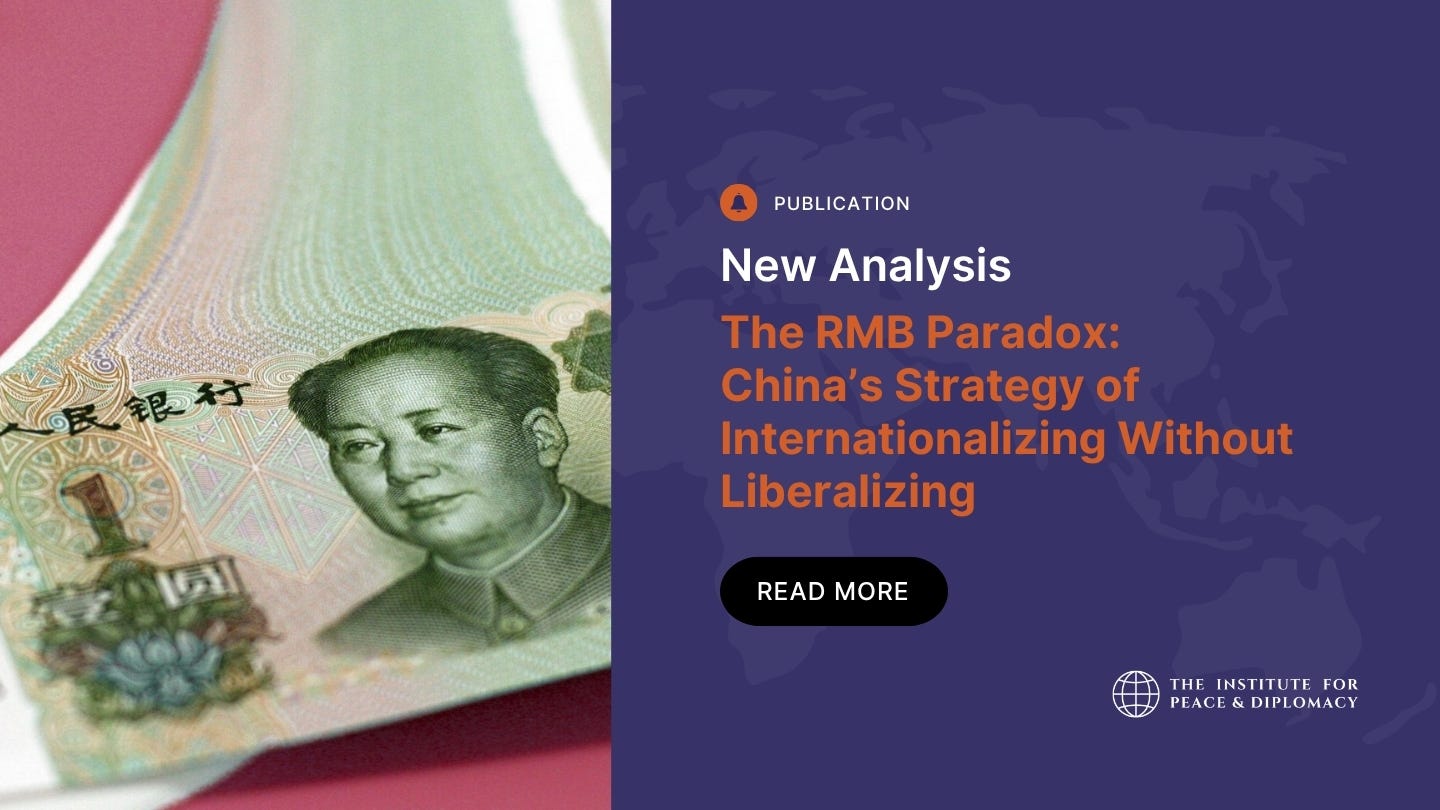
China’s RMB internationalization is simultaneously an instrument to exert external power and a tool to establish internal resilience. At the core of the two strategic imperatives lies the central policy trade-off: China’s mercantilist ambitions favour a widely used RMB that foreign firms, investors, and central banks are willing to hold and transact in; while strategic autarky favours maintaining capital controls and state oversight to protect domestic financial stability and preserve policy autonomy.
For just $5/month, subscribe now for full access to the Canada-China Brief as well as an exclusive invite to attend a new dialogue in Ottawa, Canada on October 9, 2026.
Data Dive
The takeaways:
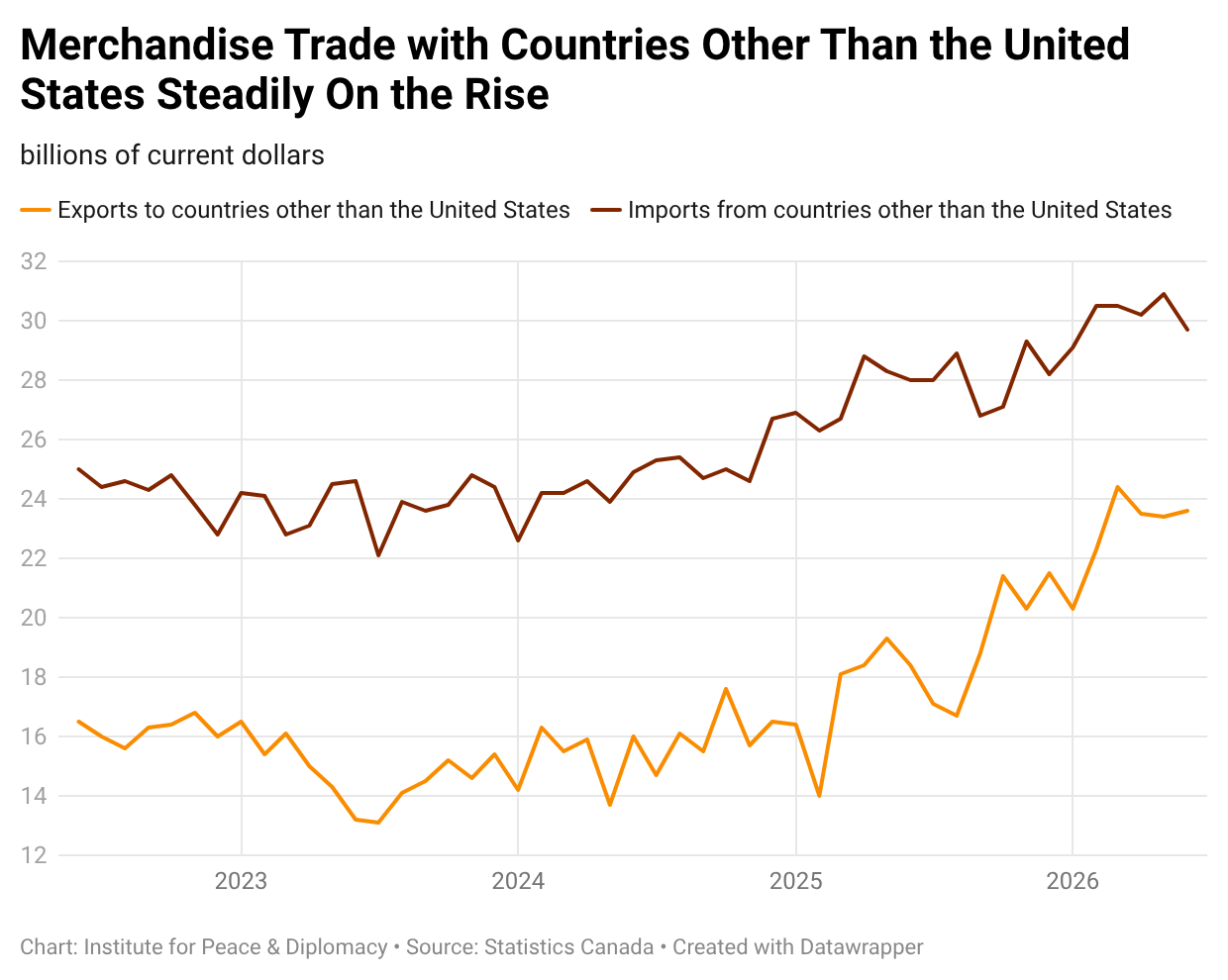
Canada’s non-U.S. merchandise trade has steadily expanded 78.8% from June 2023 to June 2026, indicating early success in trade diversification
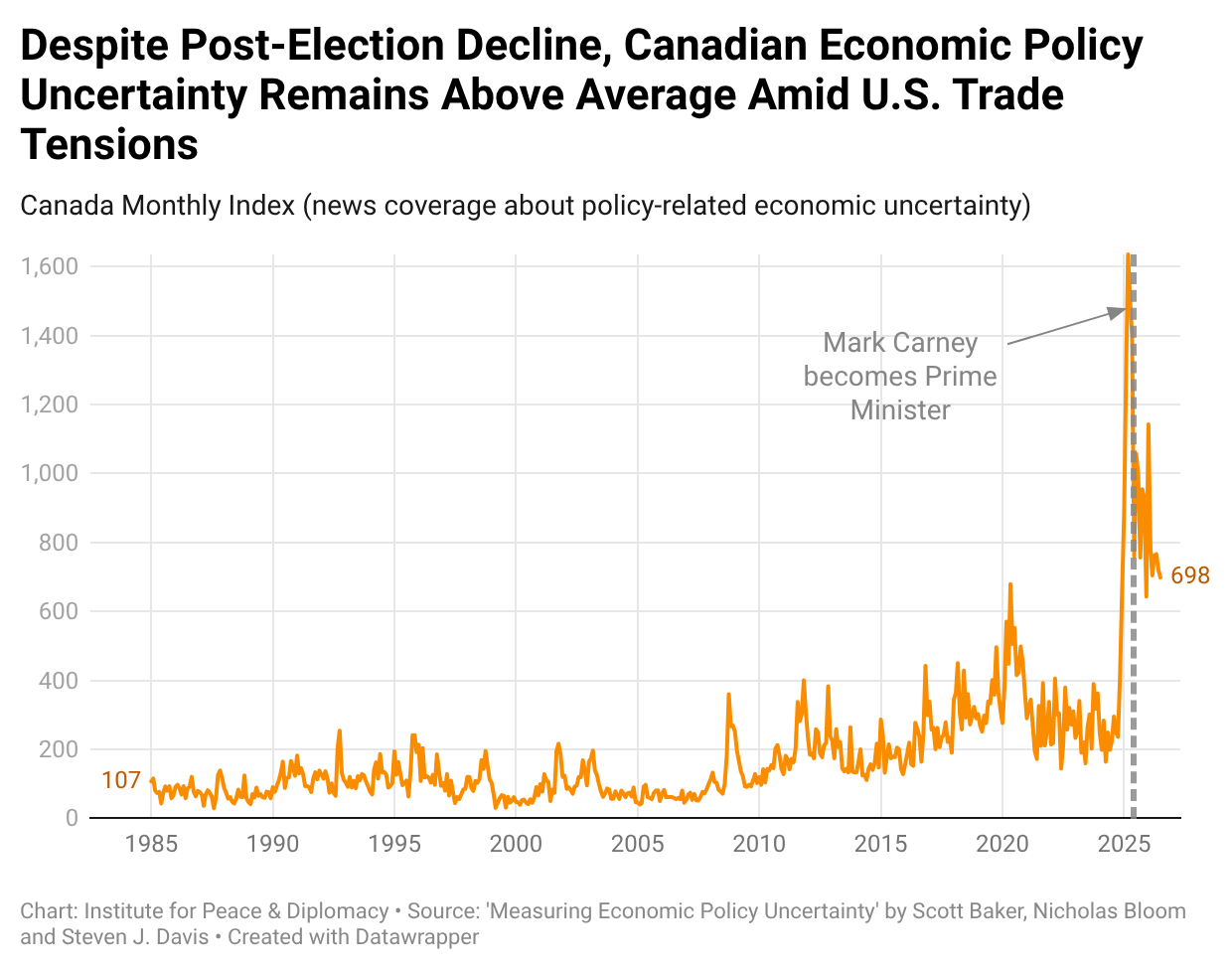
Despite a dip following Mark Carney’s election, economic policy uncertainty has remained elevated as Canada-U.S. diplomatic tensions persist
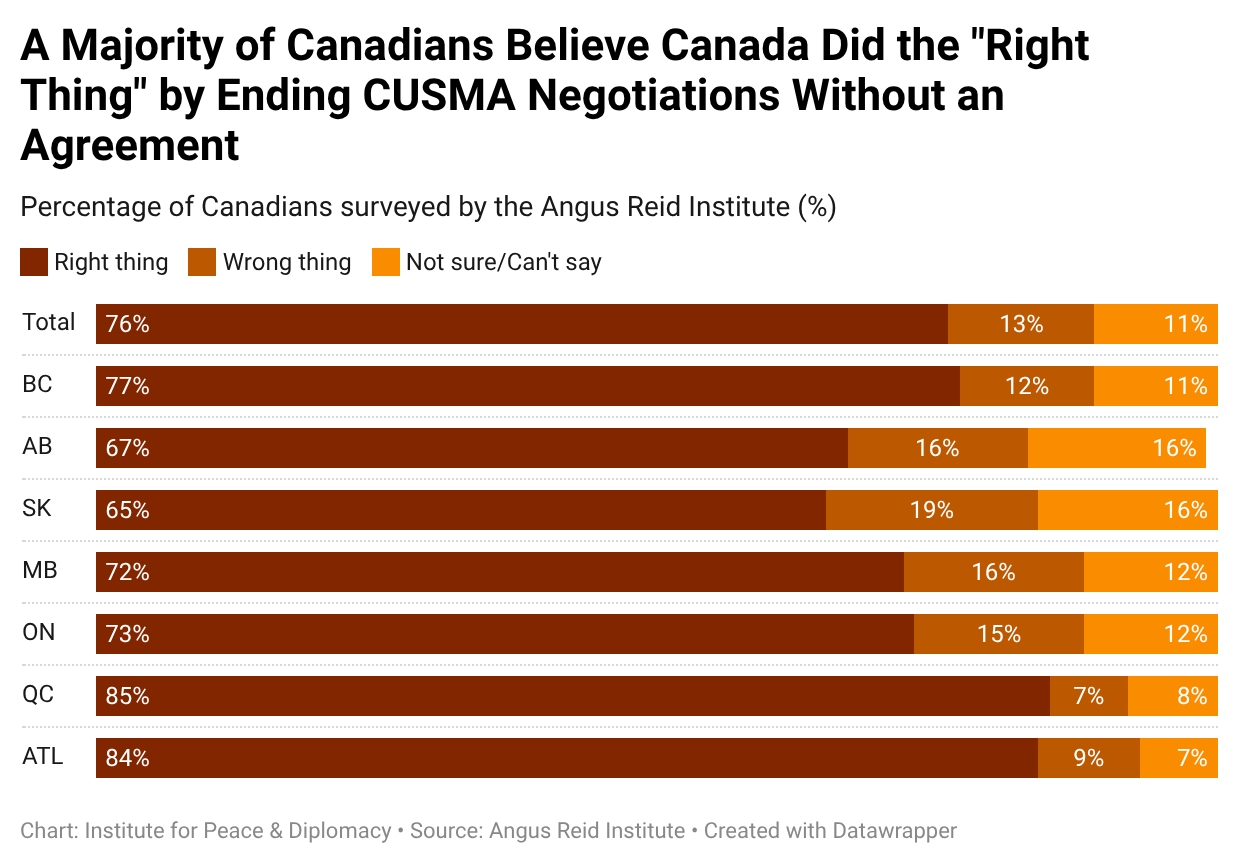
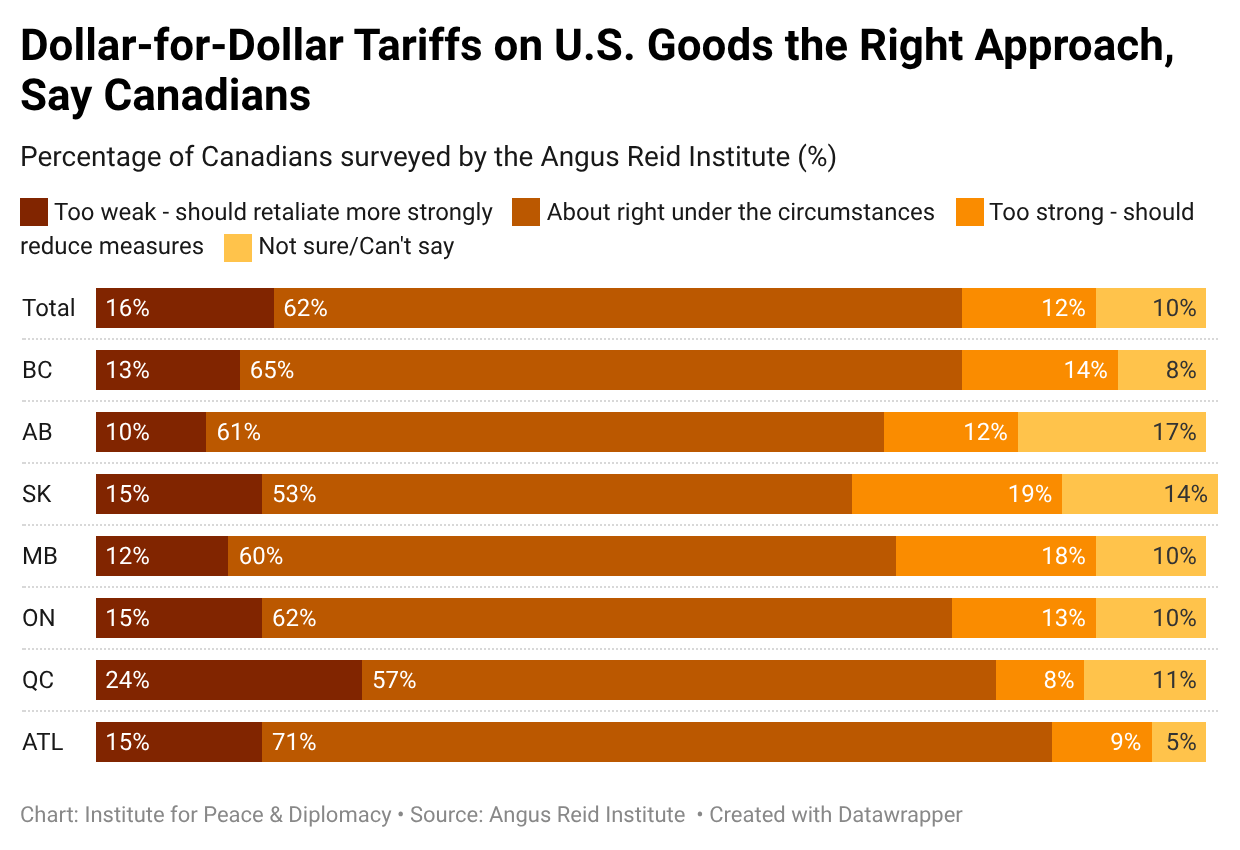
Canadians appear resilient, with 76% supporting the decision to exit trade talks and 78% favouring stronger dollar-for-dollar retaliatory tariffs
What’s next below the paywall:
A look at the numbers tracking the rise in trade investigations speared against China globally relative to all other economies
Liu Dan: Research Fellow, Center for Regional and Country Studies, Guangdong University of Foreign Studies
Duan Xiaolin: Assistant Professor, Global and Area Studies, Chinese University of Hong Kong-Shenzhen
IPD highlights the numbers that matter. Access more data analysis below the paywall by subscribing now for just $5/month.
Top Story
Carney Pushes for Trade Autonomy as Defence Dialogue Resumes
CUSMA breaks down — The PM recalled trade negotiators over last-minute U.S. demands, triggering a narrative war and placing Beijing at the center of the fallout:
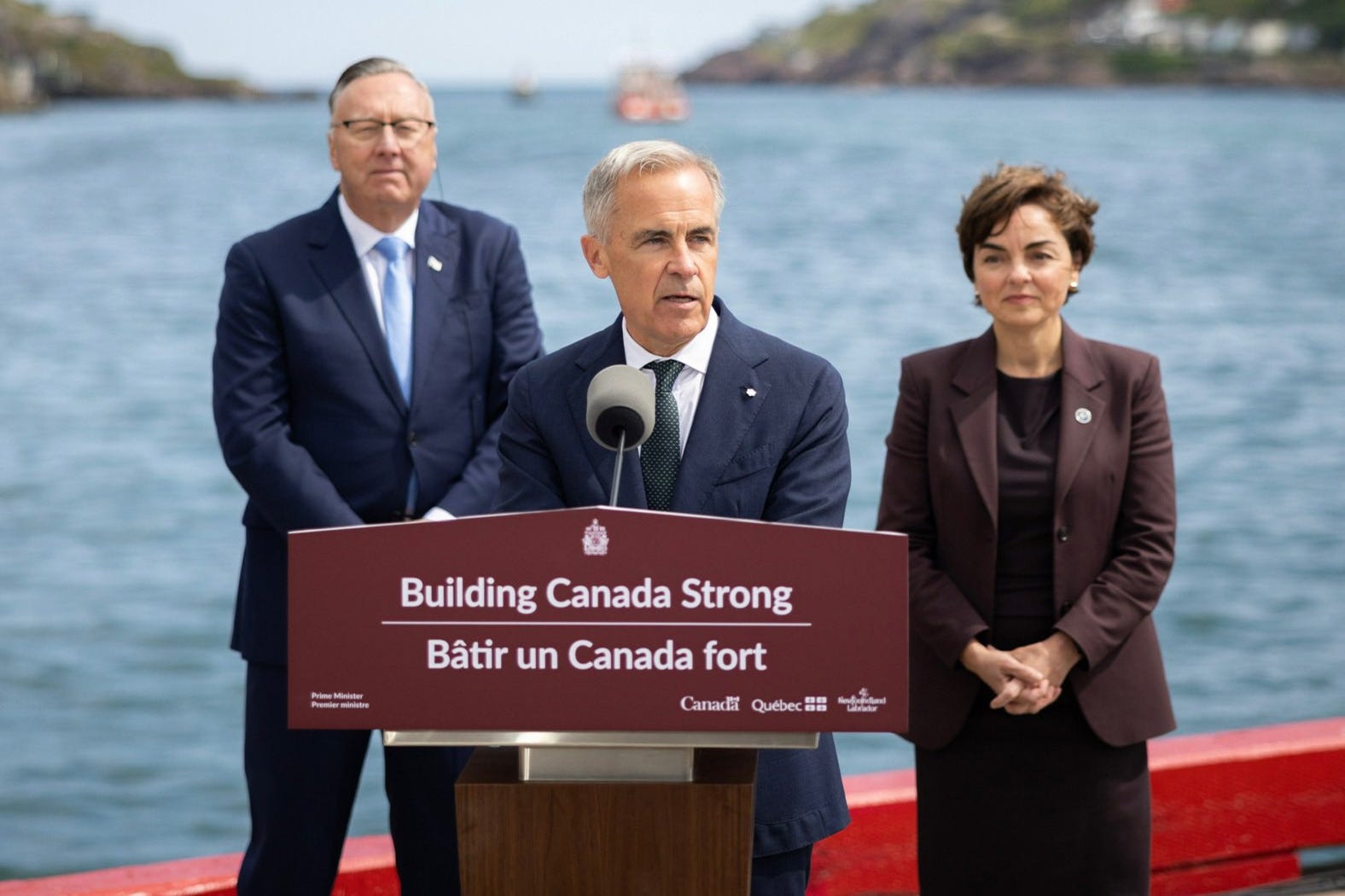
Carney rejected a U.S. proposal he characterized as unfair, saying “we were not prepared to compromise Canada’s sovereignty, or undermine our key industries” over issues that were “never on the table,” including demands that Washington be allowed to limit Ottawa’s free trade agreements with other countries.
President Donald Trump reacted by threatening new 50% tariffs starting in the new year on Canadian cars, trucks, and steel, stating that if Canada built autos in the U.S. instead, there would be zero tariffs, adding that “Canada will be treated like a State no longer!”
In the aftermath, U.S. Trade Representative Jamieson Greer compared Ottawa to Beijing, reiterating that “as President Trump has introduced a trade policy to reshore American production and protect American jobs, two countries have retaliated against the United States, the People’s Republic of China and Canada.”
Vice President J.D. Vance has also weighed in on Canadian retaliation, saying “I would expect that from China. I would not expect that from Canada,” adding that “they treat Chinese goods more fairly than they do the goods that come from the people of Maine: It’s insanity.”
Seeing red — The U.S. administration has widened its rhetorical offensive equating Canada with China as Chinese firms continue to explore investment in Canada:
In a press release, the White House declared that “Canada is joined only by the People’s Republic of China in choosing retaliation over negotiation,” citing the bilateral trade deficit to justify its measures and stating that “Canada’s failed trade policies are driving its own manufacturers south.”
It comes after a report from the White House’s Office of Trade and Manufacturing Policy last month that designated Canada a first-tier offender enabling the transshipment of Chinese-sourced exports to the U.S. market, with Vance saying Ottawa is “[allowing] itself to be used as a back door for Chinese goods.”
The report itself argues that the “countries that comprise China’s Shadow Transshipment Network include many of America’s largest trading partners. China’s biggest enablers range from Mexico and Canada on U.S. land borders," where Chinese goods “improperly secure [CUSMA] treatment.”
Former Alberta Premier Jason Kenney responded to the dispute, noting that “part of their complaint against Canada appears to be that we are, apart from China, the only trading partner to have reciprocated. And I say, darn right we are. That shows that we have some self-respect.”
The row comes as Chinese auto giant BYD has made inquiries into taking over and restarting production at a closed Stellantis plant in Brampton, with local mayor Patrick Brown disclosing that Leapmotor, another Chinese EV manufacturer, has also approached the city with the same possibility.
Militaries meet — Amidst the row, Canada and China reactivated a long-dormant defence dialogue last week on the sidelines of a military conference in Victoria.
At the setting of the Indo-Pacific Chiefs of Defence Conference, both sides met for the fifth Defence Coordination Dialogue, the first in eight years, with the Chinese readout noting both “expressed willingness to strengthen practical exchanges and cooperation… and enhanced mutual understanding and trust.”
A Department of Defence spokesperson stated that the meeting was “consistent with Canada’s broader defence engagement with partners across the Indo-Pacific region and is anchored in our commitment to protecting the safety of Canadians and the strategic interests of Canada.”
Also in Victoria, U.S. Pacific Command Admiral Samuel Paparo met with Beijing’s delegation led by General Yang Zhibin, Commander of China’s Eastern Theatre Command, as Washington stated that both “discussed the importance of maintaining open lines of communication… to reduce the risk of miscalculation.”
General Jennie Carignan, Canada’s Chief of Defence Staff, was not scheduled to meet the Chinese delegation, but spoke to media at the conference, remarking that “there is a clear demand from the government to recalibrate and realign our relationship with China.”
Beijing seizes narrative — Chinese media have reframed the Canada-U.S. breakdown to project its own trade philosophy as commentators underlined sovereignty:
The Global Times framed Ottawa’s retaliation as a “Chinese-styled counterattack,” declaring that “Canada’s response offers the world a glimpse of what China has long stood for: responding firmly and proportionally; defending sovereignty without compromise; and resorting to rules and legitimate countermeasures.”
Yu Tiejun, Director of Peking University’s Institute of Global Strategy, cautioned that “the latest row will undoubtedly push [Canada-U.S.] bilateral ties into considerable tension in the short term. In the long term, however, I do not believe the two sides will drift too far apart”.
John Gong, Professor at the University of International Business and Economics, noted Canada “stood firm” on national sovereignty, adding that holding this line is “certainly beneficial for China-Canada trade” and that China could play a supportive role by purchasing more Canadian oil.
Former Conservative leader Erin O’Toole argued that Ottawa “can collaborate with respect to some of the Chinese disruption on global trade and we probably should,” but should never “allow Washington to dictate what we do or how we regulate or what other countries we may partner with.”
From the Experts
IPD brings what scholars and opinion leaders in China and Canada have to say on the challenges both countries face.

Louis-Vincent Gave
CEO, Gavekal Research | READ
Carney’s decision was driven by the shifting geopolitical landscape. The deal the U.S. put on the table, one which involved Canada essentially turning its back on China, a rapidly growing trade partner, would have left Canada as essentially an economic dominion of the United States. This would be hard to swallow even at the best of times, and with the best of allies. But obviously the U.S. in the past few quarters has hardly been the best of allies to Canada. [...]
Against such a backdrop, it is perhaps not that surprising that Carney was not that enthusiastic about tying his country’s economic fortunes ever more closely to those of a U.S. whose political decision-making process appears increasingly both aggressive and unpredictable. After all, if Canada agreed today to sever economic ties with China, who is to say what the U.S. might ask for tomorrow? […]
Another interesting angle to Mark Carney’s decision to slam the door in President Trump’s face is the image that this will portray of Canada to the rest of the world, and especially to China. This matters because until 2018, Chinese investors had been keen buyers of Canadian assets (it’s not for nothing that Vancouver is sometimes referred to as Hongcouver). But this appetite for Canadian assets stalled with the arrest of Meng Wanzhou (the Huawei CFO) and the sudden perception that, when it came to tensions between the U.S. and China, Canada would always side with the U.S. This made Canadian assets a lot less attractive to Chinese buyers. To the extent that this perception now shifts again, the loonie could suddenly find a Chinese, and foreign, bid once again?
The Word in China

Liu Feng
Chief Economist, Green Finance Institute, Central University of Finance and Economics; Director, China Chief Economist Forum | READ
The U.S. decision not to renew the USMCA has further shaken the institutional foundations of the bilateral relationship. It should be recognized that the political impact of this episode outweighs its economic effects: the erosion of political trust between the two countries, and the shock to the very foundations of the “world’s closest bilateral economic and security relationship,” cannot be measured by GDP losses alone. […]
The Carney government’s tough countermeasures are both a response to U.S. unilateralism and a turning point in Canada’s reorientation of its national economic strategy. The fallout from this conflict may extend beyond the bilateral sphere: it accelerates the reversal of North American integration, injects new momentum into global supply chain restructuring, and opens up room for cooperation with third parties, including China.
For China, this represents a strategic window that calls for careful handling. The complementarity of China-Canada trade, Canada’s urgent need for trade diversification, and the market space opened by China’s 15th Five-Year Plan converge to create a rare opportunity for cooperation. But opportunities do not automatically materialize—they require good faith and practical action from both sides. In a time of profound global trade realignment, those who adapt faster and more flexibly to expand cooperative networks will gain the upper hand in a changing world.

Liu Dan
Research Fellow, Center for Regional and Country Studies, Guangdong University of Foreign Studies | READ
The establishment of a defense dialogue mechanism between the two countries was originally intended to enhance mutual trust, avoid miscalculation, and coordinate positions. This not only serves the national interests of both countries, but is also conducive to peace and stability in the Asia-Pacific region and the world at large. […]
From Canada’s perspective, a key factor that cannot be ignored in the restoration of this meeting mechanism is Canada’s reassessment of its own strategic situation, especially its profound doubts about America’s reliability. Over the past few years, Canada’s security and economic dependence on the United States has not earned it equal respect, and it has repeatedly been treated rudely under ‘America First’. From the Trump administration’s imposition of tariffs on Canadian steel and aluminum products on national security grounds, to threats to withdraw from the USMCA, to pressuring Canada to take sides in its China policy, Ottawa has gained a firsthand understanding of the instrumental nature and uncertainty of Washington’s so-called ally status.
See more in translation under the paywall.
Thanks for reading the Canada-China Brief from the Institute for Peace & Diplomacy! Subscribe now for just $5/month for full access to Data Dive and The Word in China coverage below, including extended analysis and translated expert commentary