

This week’s Canada-China Brief offers exclusive insight:
Carney and Xi’s moment: Review the latest in Carney’s push to reorient relations after meeting Xi Jinping and sending more ministers to Beijing
Data Dive: Key numbers, charts, and analysis on changing trade patterns as U.S. exports fall and China increasingly takes up Canadian oil
Expert voices: New analysis from experts in both Canada and China sheds light on a full view of world events
Subscribe for just $5/month or $50/year to access full analysis, stay ahead of the curve on Canada-China relations, support independent, policy-driven coverage, and gain discounted access to our upcoming 5th Indo-Pacific Strategy Forum, taking place in 10 days on Parliament Hill in Ottawa.
5th Indo-Pacific Strategy Forum 2025
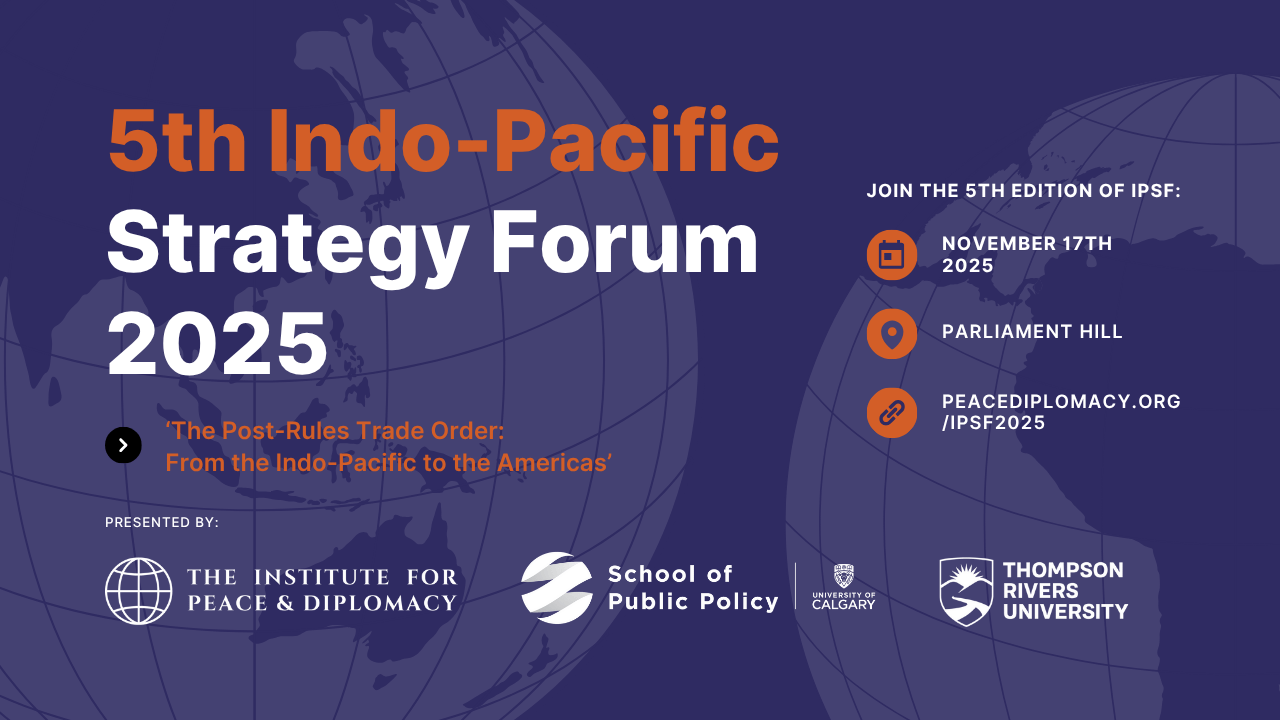
We’re now just 10 days away from the 5th Indo-Pacific Strategy Forum (IPSF) — Canada’s largest international conference on the Indo-Pacific — taking place on November 17, 2025, at Parliament Hill in Ottawa. Secure your spot and purchase your ticket today.
👉 For inquiries, please reach out to IPD’s Fundraising and Development Officer Fiona Nicholson at fiona@peacediplomacy.org. Paid subscribers to the Canada-China Brief will qualify for a 15% discount ($30) to the Indo-Pacific Strategy Forum, Canada’s premier Indo-Pacific geoeconomic conference in Ottawa.
Top Story
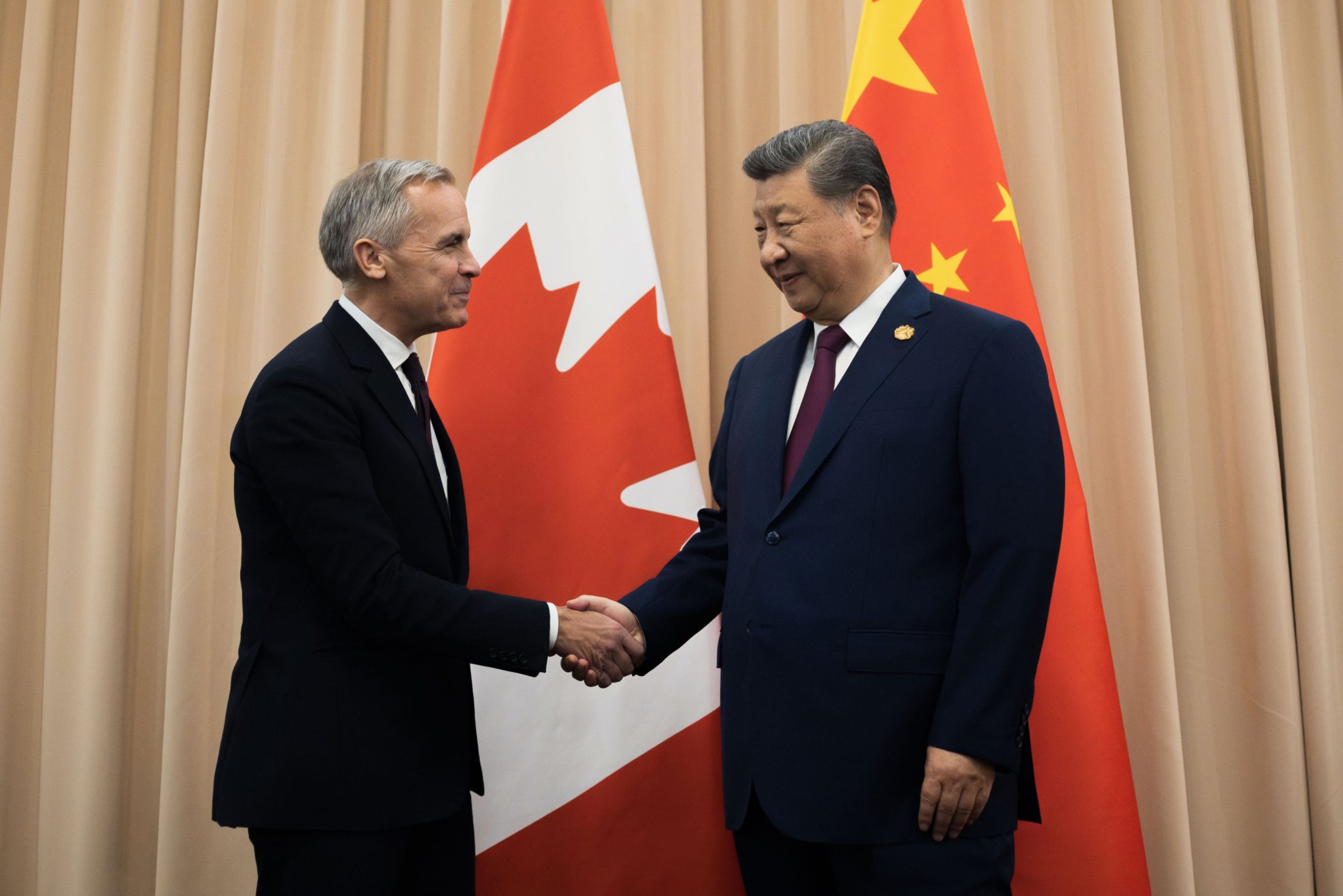
Carney and Xi Set Stage for Reboot, Budget Vows Diversification
‘Long overdue’ — Under the backdrop of APEC in South Korea, PM Carney held formal talks with Chinese President Xi Jinping, calling it an opening of opportunity:
Ottawa’s readout said both sides committed to “renewing the relationship between their two countries in a pragmatic and constructive way” and working to “move quickly to resolve outstanding trade issues” such as agriculture and electric vehicles, while also discussing a potential framework for structured cooperation.
President Xi noted that this year marked the 20th anniversary of the bilateral Strategic Partnership as Beijing’s account stated that Canadian counterparts conveyed that Ottawa “places high importance on its relations with China [and] wishes to seize the opportunity of the improvement of bilateral ties.”
In Carney’s remarks to APEC corporate leaders, he described how the “old world of steady expansion of rules-based liberalised trade and investment… that world is gone. I think we have to be cleareyed about that reality because nostalgia is not a strategy.
In a press conference, Carney climbed down from earlier election campaign rhetoric calling Beijing Canada’s biggest security threat, saying that “the advantages of having your security clearance is you’re better informed about some of the threats.”
Asked whether he stands by the Indo-Pacific Strategy’s designation of China as a ‘disruptive power’, Carney reframed his view as one in which the “disruption that comes from China brings also opportunity,” highlighting “pragmatic engagement” including Chinese purchases of oil and gas from the West Coast.
Tripling trade — Ahead of and within Ottawa’s federal budget announcement, Carney explicitly set goals to elevate non-American exports:
In a recorded message to Canadians, Carney promised that his ”number one focus is to put Canadians back in control by building here at home and building new partnerships abroad so that we’re not reliant on the United States… yes, we’ll keep trading with the U.S., but we will double what we export to everywhere else.”
The 2025 Budget ushered in a formal ‘Trade Diversification Strategy’ committing to the doubling target equivalent to $300 billion, with measures including export financing and firm-level subsidies for market diversification, while vowing to “focus its efforts on the Indo-Pacific — a pivotal source of long-term demand.”
In an interview, Chinese Ambassador to Canada Wang Di stated that “what I’m looking forward [to] is not only double our trade. If both sides have enough compatibilities and have enough competitive products, why not make this trade triple than what we already have now.”
Ministers in China, Carney to follow? — The PM welcomed an invitation to visit China during his talks with Xi Jinping as he has deployed more ministers to Beijing:
Beijing assumed the APEC chairmanship from South Korea at the conclusion of the summit in Gyeongju, positioning it as the next host of the group’s leaders in 2026 and marking the first clear opportunity for Carney to undertake a mission to the country.
Soon afterwards, Agriculture Minister Heath MacDonald returned from Beijing after holding talks with Minister Sun Meijun of the General Administration of Customs to re-open market access for Canadian food exports in a bid to lift restrictions on canola and pork.
MacDonald also spoke at the Canada China Business Council, declaring that the new federal budget will be “transformational not just for Canada, but for those countries like China” as Ottawa diversifies its trade, saying that “it’s a partnership that we need — we need to strengthen it… our trade relationship is a partnership.”
What commentators are saying — Stakeholders from across the political spectrum have increasingly united on moving forward to resolve the EV dispute with China:
Saskatchewan Premier Scott Moe remarked that the Carney-Xi meeting “really does signal — and it is my hope — that we’ll be able to deliver on resetting that relationship from a trade perspective. Obviously, we would hope for a removal of all the tariffs that are in place after this meeting.”
In a letter to Carney last month, Manitoba Premier Wab Kinew wrote that the current tariff policy “has created a two-front trade war that disproportionately impacts Western Canada,” demanding Ottawa “eliminate the EV tariff in exchange for restoring full access for Canadian agricultural products to the Chinese market.”
The Conservative Party’s Saskatchewan Regional Caucus of MPs from also issued a group letter coinciding with Carney’s meeting with Xi, stating that “the federal government must immediately work to lift these tariffs so our producers can get their canola and pulses to market.”
Stewart Beck, former High Commissioner to India, suggested that “instead of just blocking Chinese EVs… create joint ventures that bring Chinese EV technology to Canada,” arguing that Canada must be “building concrete alternatives that reduce our vulnerability to a partner whose decisions can shift on a moment’s notice.”
From the Experts
IPD brings what scholars and opinion leaders in China and Canada have to say on the challenges both countries face.
The Word in Canada

Sergio Marchi
Advisor, Institute for Peace & Diplomacy; Former Minister of International Trade and Ambassador to the World Trade Organization
The Canada-China relationship has been in the deep freeze for far too long, so PM Carney’s recent meeting with President Xi is hugely important. In fact, the last face-to-face meeting between our leaders was 8 years ago. And that’s an unforgivably long time.
Back in 2015, Justin Trudeau had a golden opportunity when the Chinese invited him for a state visit soon after he was elected Prime Minister. The reason for the quick embrace was two-fold. First, his father, Pierre Trudeau, was still revered in China for being one of the first Western leaders to recognize China diplomatically. And secondly, bilateral ties had suffered miserably from Harper’s anti-China ideology. There was much promise in a fresh start. But it was poorly managed by Trudeau. Moreover, there were a number of difficult conflicts that together relegated the relationship back into the freezer.
PM Carney has taken the right steps to reinvigorate and re-energize this partnership. He has spoken to both the Premier and President of China and, as a result, been issued an invite to visit Beijing in the new year. Hope is once again alive. Whatever people may think of China, the country is too big to isolate or ignore. They are a monumental player, economically and politically, on the global stage, and Canada must urgently reconnect. That’s why under the Chretien administration, China was a top foreign policy priority, which translated into alternating annual visits by our respective leaders, ministers, and officials.
We have to get back to that model if we are to extract maximum mutual benefits. And the timing could not be better. As Trump continues to unfairly punish our economy, and as Carney is working diligently to diversify our trade and investment policies away from America, a thaw with China would be most welcome and helpful.
Now, be prepared for some bumps and bruises along the way. The current Chinese leadership is much more belligerent than in the past when I served as trade minister, but it is clearly in Canada’s national interest to develop and maintain a sound engagement with this populous country. This time, we must not waver. We can do this.

Hugh Stephens
Advisor, Institute for Peace & Diplomacy; Former Assistant Deputy Minister, Policy and Communications, Global Affairs Canada
The Carney-Xi bilateral meeting in Korea was a welcome step in restoring a semblance of normality and dialogue to an extremely strained relationship. The groundwork had been laid by the recent visit to China of Minister Anand and the Prime Minister’s meeting with Premier Li Qiang in New York, but the meeting with Xi was the necessary capstone to getting the relationship back on to a more constructive plane.
The fact that Xi invited Carney to visit China, an invitation quickly accepted, will set in motion a process that should lead to some progress on contentious issues by the time of that visit, which is yet to be determined. Canada needs the Chinese market if it is to pursue its goal of diversifying trade by doubling exports to non-U.S. markets over the next decade. That said, it will require finesse and a careful evaluation of core Canadian interests as Canada explores expansion of trade and investment ties with China while simultaneously evaluating how to deal with an unpredictable and punitive U.S. administration.
The relative relaxation of U.S.-China tensions should afford Canada some breathing room, but Canada needs to be alert not to be caught between its two largest individual export markets, as happened with the EV tariffs. While Carney has talked of asymmetric geometry in dealing with China by engaging in some areas while being much more cautious in others, it remains to be seen if China will engage on the same terms. China can be expected to push economic demands that Canada may find difficult to accept, but at least channels of communication are now reopening.

Wenran Jiang
Advisor, Institute for Peace & Diplomacy; Founding Director, China Institute and Mactaggart Research Chair Emeritus, University of Alberta | READ
A pragmatic middle path is within reach. Canada should propose a gradual reduction of its EV tariff from 100 per cent to a more reasonable 30-50 per cent, explicitly tied to China lifting its retaliatory tariffs on Canadian agricultural goods. This would provide immediate relief to our farmers and stabilize a critical trade relationship. But the negotiation will go beyond tariffs, as Carney emphasized, to include both “commercial relationship as well as the evolution of the global system.” Canada should leverage its rich lithium reserves and skilled workforce to attract Chinese investment in the domestic auto sector.
Encouraging joint ventures for battery production or EV assembly in Ontario would create the manufacturing jobs that tariffs alone promise but cannot deliver. As Carney noted, the approach must be comprehensive, seeking a broad “alignment of incentives and interests.” […] a negotiated solution would strengthen Canada’s economic sovereignty by diversifying trade partnerships and reducing overreliance on the United States.
The path forward requires strategic unity. The planned Carney-Xi meeting is a critical opportunity to translate high-level diplomacy into a balanced package: moderate EV tariff reduction in exchange for agricultural market access and binding commitments on Chinese investment.

Jeffrey Reeves
Senior Washington Fellow, Institute for Peace & Diplomacy; Associate Professor of National Security, Naval Postgraduate School, U.S. Naval War College | READ
Greater engagement with Canada [for ASEAN] offers diversification, investment opportunities, and an additional layer of economic resilience, particularly valuable amid U.S.-China tensions. Still, the larger gains are Canada’s: deepening its presence in the Asia-Pacific and demonstrating that its global role need not be defined by Washington’s approach…
The goal should be to make Asia a natural extension of Canadian commercial engagement rather than a secondary consideration. By engaging on Asian terms and emphasising partnership over preaching, Canada can carve out a modest but credible role as a constructive regional actor.
The Word in China

Xu Yanzhuo
Assistant Research Fellow, Institute of World Economics and Politics, Chinese Academy of Social Sciences | READ
The Carney government is shifting from an ‘ideology-first’ approach to selectively engaging with diverse countries and regions while maintaining reliance on the United States, in an attempt to break the ‘single-line dependence’ on the U.S. However, because Canada needs to prioritize maintaining its relationship with the United States, its room for strategic adjustment is very limited…
For Canada, deepening relations with China could alleviate pressure from a potential Trump administration. For China, an improved relationship with Canada would help secure cooperation from more U.S. allies, while sending a clear message: within the framework of its alliance with the United States, it is entirely possible to develop pragmatic relations with China. This would not only ease the pressure from potential ‘blame-shifting’ by a Trump administration but also avoid falling into the predicament of comprehensive confrontation and decoupling with China. This is undoubtedly a positive trend.
What’s next below the paywall:
Liu Dan: Research Fellow, Center for Canadian Studies, Guangdong University of Foreign Studies
See more Chinese commentary below the paywall by subscribing now for just $5 a month.
Data Dive
The takeaways:
Public surveys continue to indicate a growing reversal in Canadian sentiment towards levies on China, with almost half of Canadians opposing EV tariffs
Opposition to tariffs has quickly shifted and nearly doubled from 27% in 2024 to 47% in 2025
Initial Canadian support for EV levies has almost halved from 43% to 22% in just a year’s time
What’s next below the paywall:
Port of Vancouver data indicating China continues to surpass the U.S. as the West Coast’s biggest crude buyer over the past two years
Annual comparison of changes in Canadian exports as U.S. trade has fallen and exports to all other markets including China have grown
Tracking monthly growth in two-way trade between Canada and China since 2006
IPD highlights the numbers that matter. See more data analysis below the paywall by subscribing now for just $5 a month.
Thanks for reading the Canada-China Brief from the Institute for Peace & Diplomacy! Join a free trial now for full access to Data Dive and The Word in China coverage below, including extended data analysis and translated expert commentary