

This week’s Canada-China Brief offers exclusive insight:
Many baskets: Review the latest as Carney previews his vision for China relations and moving beyond ‘eggs in one basket’
Data Dive: Revisit the key numbers, charts, and analysis that the Brief highlighted over 2025
Expert voices: New analysis from experts in both Canada and China sheds light on a full view of world events
Subscribe for just $5/month or $50/year to access full analysis, stay ahead of the curve on Canada-China relations, and support independent, policy-driven coverage.
Top Story
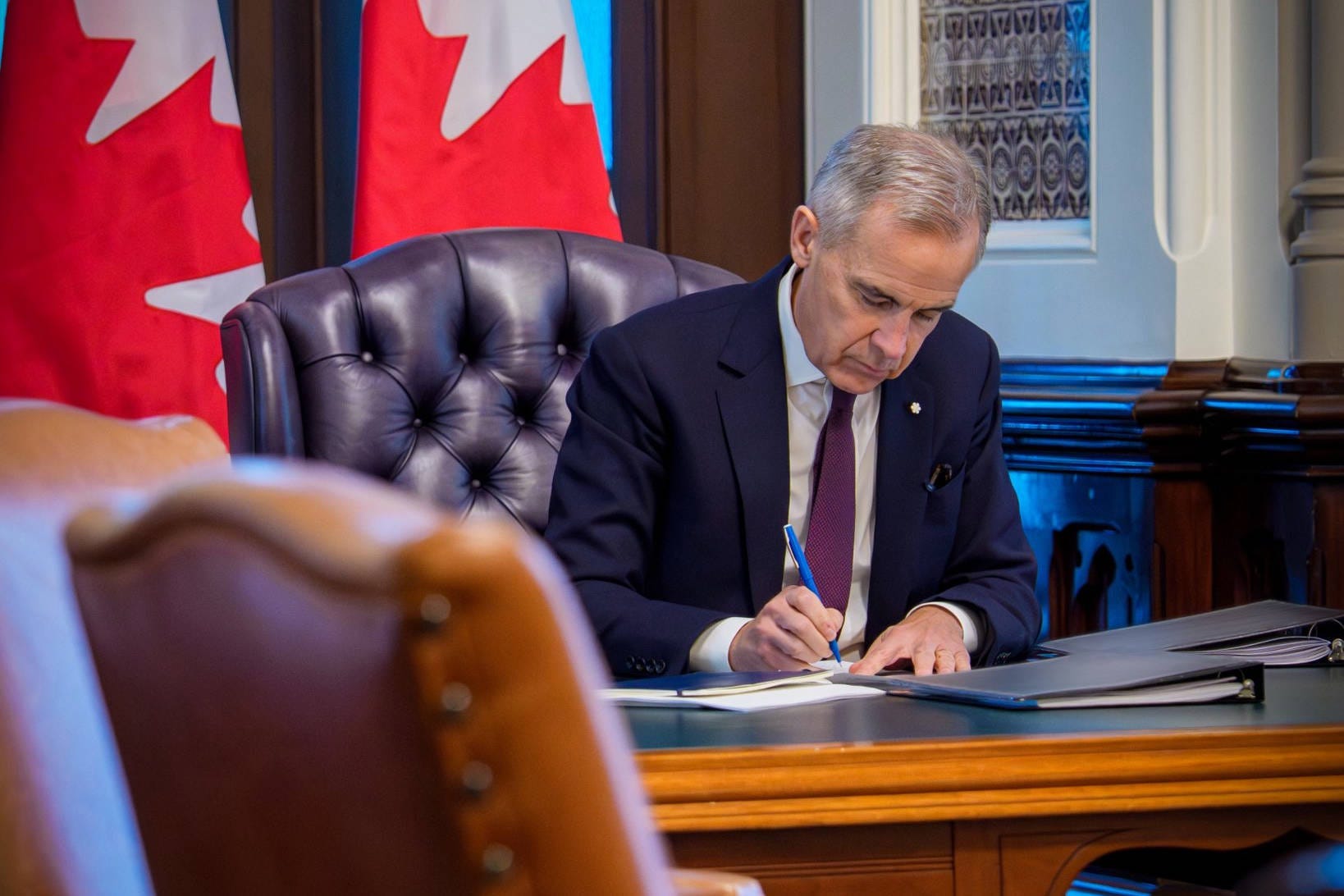
In Year-End Interview, Carney Lays Out Parameters for China Relations
‘Trump respects my rapprochement’ — In a wide-ranging interview on his first year in office, Prime Minister Mark Carney outlined his view of relations with China:
Noting his personal rapport with President Trump, Carney stated that his American counterpart “respects that we have launched trade negotiations with India, and that we’re having a rapprochement with China… All of those steps are in Canada’s interests. But yes, they respect that.”
The PM stressed that one should “never have all your eggs in one basket. We have too many eggs in the American basket. We would like to maintain that relationship and grow others, but we absolutely need to grow others, and the ‘S’ is a capital ‘S’ at the end of ‘others’. So it’s India, it’s China, yes.”
Reckoning with caution, he also asked “how deep is the relationship, and how clear are the guardrails around that relationship? There are areas — artificial intelligence, critical minerals, defence, where clearly the security threats are such that we would not have a deep relationship with China in those areas.”
Urgent pragmatism — The flurry of delegations to China since Carney’s meeting with Xi Jinping has continued this month, with Chinese officials also visiting Ottawa:
Deputy Foreign Affairs Minister David Morrison and Parliamentary Secretary to the PM Kody Blois joined forces in a visit to Beijing this month alongside Canada’s Chief Trade Negotiator Aaron Fowler where the group held discussions with China’s Ministry of Commerce and Vice Foreign Minister Ma Zhaoxu.
Anita Anand described the mission as “laying the foundation for a leader-level visit. The bilateral relationship is complex. It does not rest on one issue alone, and it is important for numerous points of conversation to be addressed prior to a leader-level visit,” saying she is guided by “pragmatism imbued with urgency.”
She also noted that “geopolitically and in terms of the world trading order, both of those issues are undergoing rewiring, and for Canada, that means ensuring that we double non-U.S. trade over the next 10 years. That’s the starting point… so that we are never again 80 per cent dependent on one economy.”
Early this month, Canadian senators hosted a Chinese delegation of lawmakers in Ottawa for the twenty-fifth bilateral meeting of the Canada-China Legislative Association, with the group holding a stakeholder engagement with LNG Canada in a stopover in Vancouver.
Assistant Deputy Minister Tara Denham of Global Affairs Canada also hosted Chinese counterparts led by Long Zhou, Director-General of Consular Affairs at the Chinese foreign ministry, as both sides held a fifth round of consultations on consular issues.
What commentators are saying — Experts have noted the reorientation in Canada’s China posture as the U.S. imperative weighs on Ottawa’s calculations:
Former Canadian Ambassador to China Guy Saint-Jacques observed that “in a way, we have no choice. We have to engage with China… it’s a superpower on the political side. We have to ask them to put pressure on Russia to stop the war in Ukraine. We have to tell them to be careful with what they do with Taiwan.”
Diego Marroquín Bitar, Fellow at the Center for Strategic and International Studies, cautioned that given alignment with the U.S. on China and the risk that D.C. may strike its own bilateral deal, “Mexico and Canada may end up paying the price of a strategy that no longer reflects the direction of U.S.–China relations.”
Mark Kruger, Senior Fellow at the Centre for International Governance Innovation, questioned whether U.S.-China relations are a 'house of cards’, saying “so much depends on the two countries finding a modus vivendi” and that tariff rollback “would certainly be helpful for the United States, China and the rest of the world.”
Julia Bentley, Senior Fellow at the Munk School, suggested that “with a recalibration of Canada-China relations in the offing, Canada will benefit from having more people who understand what is actually going on in China” as the need for competency grows.
From the Experts
IPD brings what scholars and opinion leaders in China and Canada have to say on the challenges both countries face.
The Word in Canada

Jeff Mahon
Director, Geopolitical and International Business Advisory, StrategyCorp; Former Deputy Director, China Division, Global Affairs Canada | READ
Canada is striving to find a pragmatic foreign, economic and security policy that corresponds to the complex economic security regime taking shape.
Non-market practices and economic coercion are no longer the sole purview of China. The global economy is now a battlefield in geopolitical competition, and the US has demonstrated over the past year that it won’t be restricted by liberal political norms and free-market commitments in its pursuit of global dominance.
The takeaway from Canada’s situation is that the lines between friend and foe have blurred. Countries will be better served by compartmentalising their interests and organising their international relationships accordingly.
The Word in China

Zhang Monan
Deputy Director, Institute of American and European Studies, China Center for International Economic Exchanges | READ
The United States-Mexico-Canada Agreement (USMCA) is heading toward its first review in 2026. U.S. President Donald Trump has said he wants to renegotiate the deal, potentially splitting it into separate U.S.-Mexico and U.S.-Canada bilateral agreements or tightening rules of origin to increase U.S. benefits, to address the challenge posed by China’s global supply chain arrangements via Mexico. The USMCA contains a six-year review clause, which the U.S. views as a lever to apply pressure and amend arrangements it finds unfavorable. Under the Trump administration’s “America first” policy, any short-term victory beneficial to domestic manufacturing or labor has significant political value. By threatening withdrawal or shifting to bilateral negotiations, the administration can achieve a stronger negotiating position with Congress and domestic interest groups…
The United States is no longer providing broadly applicable public rules; instead, it is offering “limited public goods” to specific partners. This will not only change international economic relations but also alter power structures, signaling the transformation of the postwar order from a rules-based system designed to constrain power to one driven by competition in strength.
What’s next below the paywall:
Diao Daming: Adjunct Fellow, Center for International Security and Strategy and Professor, School of International Studies, Tsinghua University
See more Chinese commentary below the paywall by subscribing now for just $5 a month.
Data Dive
In this roundup, see the Brief'‘s top highlights in 2025 of the numbers that matter. See more data analysis below the paywall by subscribing now for just $5 a month.
The takeaways:
Chinese purchases of Canadian oil have reached record levels with more than 70% of oil-carrying ships from BC directed towards the Chinese market
Canadian public opinion on recognizing the importance of economic ties with China has grown over the past decade, tripling between 2021 to 2025 alone
Approximately 62% of Canadians polled by Nanos Research now support lifting tariffs imposed on Chinese electric vehicles
Thanks for reading the Canada-China Brief from the Institute for Peace & Diplomacy! Join a free trial now for full access to Data Dive and The Word in China coverage below, including extended analysis and translated expert commentary