

This week’s Canada-China Brief offers exclusive insight:
Li to Xi: Recap Prime Minister Carney’s talks with China’s Li Qiang as Foreign Minister Anand prepares the ground for a meeting with President Xi
Data Dive: Key numbers, charts, and analysis on changing public opinion towards Canada’s tariffs on Chinese electric vehicles
Expert voices: New analysis from experts in both Canada and China sheds light on a full view of world events
Subscribe for just $5/month or $50/year to access full analysis, stay ahead of the curve on Canada-China relations, support independent, policy-driven coverage, and gain future discounted access to our annual conference below.
Indo-Pacific Strategy Forum 2025
Less than two months remain before IPD holds the fifth edition of its Indo-Pacific Strategy Forum (IPSF 2025) in Ottawa from November 17-18. Register to be notified when ticket sales open this week.
👉 Paid subscribers to the Canada-China Brief will receive a 15% off discount code for admission at a future date. Registration is now open and ticket sales will open this week with limited space available.
Data Dive
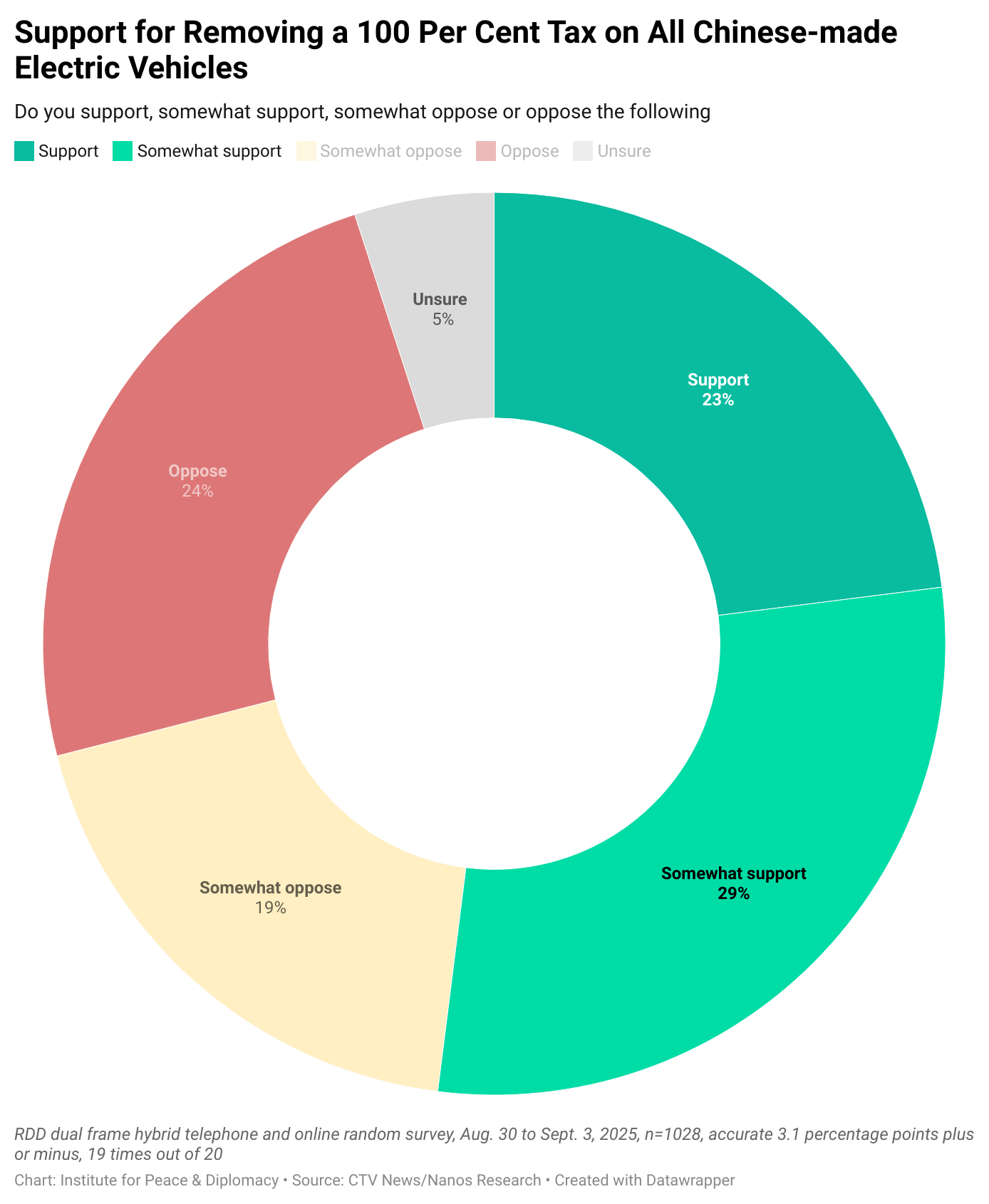
The takeaways:
Approximately 62% of Canadians polled by Nanos Research now support lifting tariffs imposed on Chinese electric vehicles
Only 3 in 10 Canadians, or approximately 29%, now support maintaining the very same levies
Comparatively, 52% of Canadians support dropping retaliatory tariffs against the United States
Polling indicates that public support for removing EV tariffs is greatest in the prairie provinces, standing at nearly 66%
What’s next below the paywall:
Evolving public polling data indicate shifts in Canadian views over the past five years that endorse increasing trade with China
IPD highlights the numbers that matter. See more data analysis below the paywall by subscribing now for just $5 a month.
Top Story
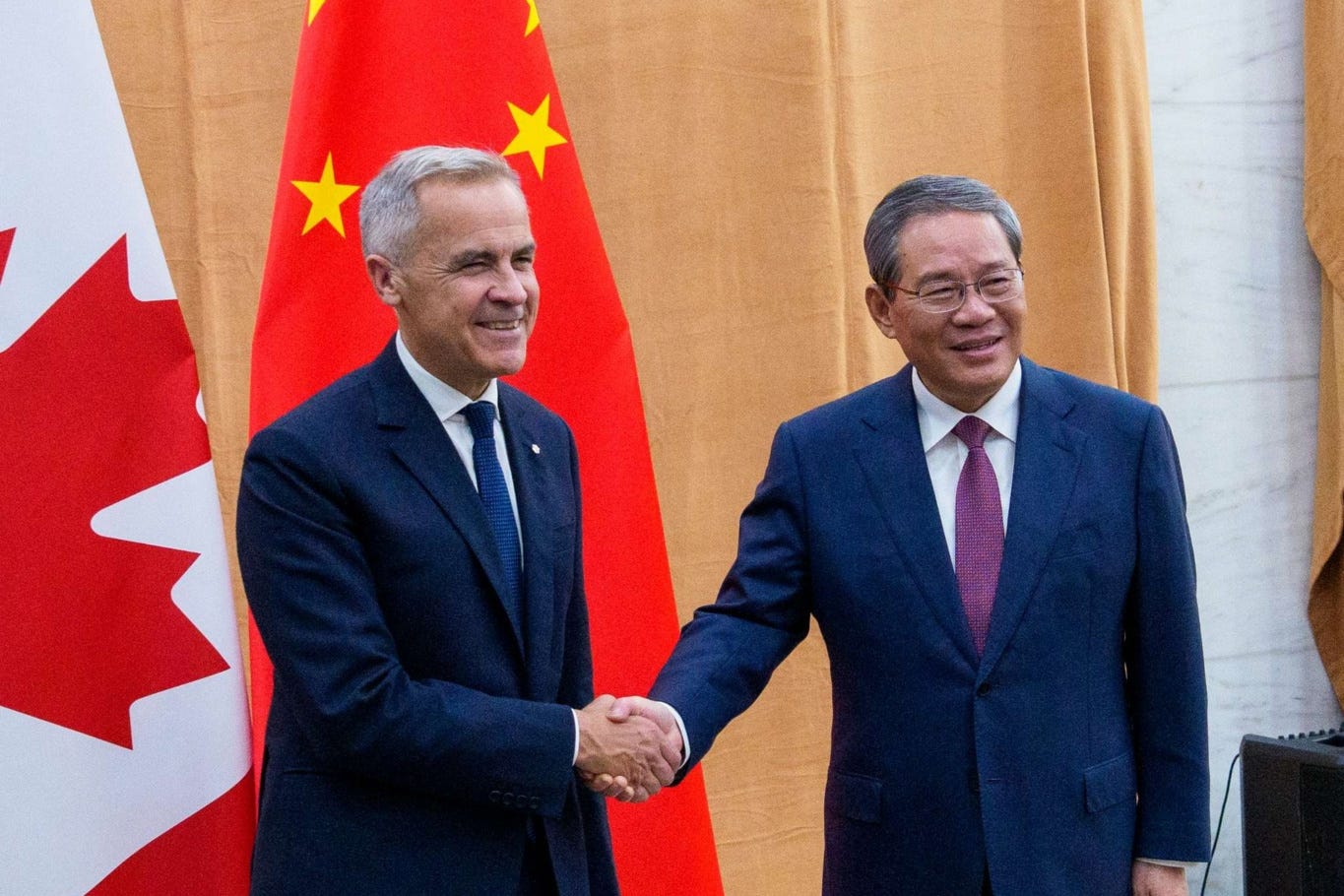
Carney Talks Re-engagement With Premier Li as EV Tariffs Reviewed
‘We’re re-engaging with China’ — On the sidelines of the UN General Assembly, Carney held discussions with China’s Premier as Ottawa revealed more talks to follow:
Ottawa’s readout of the meeting stated that both “discussed respective sensitivities regarding issues, including agriculture and agri-food products, such as canola, as well as seafood and electric vehicles,” while also affirming progress towards a leader-level meeting.
China’s account stated that Li Qiang told Carney that “with a host of new developments in the current international landscape, notably the rise of unilateralism and protectionism and the proliferation of trade restrictions, the international community should enhance solidarity” and support the WTO.
In a subsequent press conference, Carney highlighted trade Chinese imports of Canadian LNG and defended Canada’s alignment with U.S. tariffs on Chinese steel, but expressed that he will “expect at the appropriate time to be meeting with President Xi Jinping.”
Addressing the Council on Foreign Relations, the PM said that “we’re re-engaging with China” and that he seeks to improve on “being clearer about where we engage,” adding the observation from his experience that Beijing is “very sincere and engaged on climate.”
Foreign Minister Anita Anand announced a planned visit to Beijing, saying that “in this time where countries are choosing a more protectionist path, my focus as minister is to build bridges wherever possible. In this era where we see countries standing up for their own sovereign interests, there are points of commonality.”
Tariff troubles, revisited — As Ottawa begins a review of its 100% tariffs on Chinese EVs, Canada’s provinces have continued to be divided on the way forward:
The office of Finance Minister François-Phillippe Champagne revealed that a review of the levies “was initiated within the prescribed one year timeline and remains underway” as of early September, noting that Ottawa is “cognizant of the interest that many stakeholders have” in what it called “an informal process.”
Ontario Premier Doug Ford published an open letter last month defending the levies, writing that “maintaining Canada’s tariffs on Chinese-made EVs will also be critical to securing a trade agreement with the U.S. that provides relief to Canada’s tariff-impacted sectors.”
He continued to argue that “if the federal government removes its tariffs against Chinese-made EVs, you will contradict and undermine months of engagement with U.S. officials and lawmakers about the need to protect and enhance our highly integrated cross-border automotive supply chains.”
Saskatchewan’s Scott Moe, fresh from a trade mission to Beijing, said “my hope is that there’s going to be very much in the way of engagement by [federal] ministers with their Chinese counterparts” as other economies “are finding their way to a resolution on some trade disputes or irritants with China.”
What commentators are saying — Observers have noted the greater policy space for negotiation and reorientation under Carney:
Liu Dan, Research Fellow at Guangdong University of Foreign Studies’ Center for Regional Country Studies, suggested that restored senior-level talks “indicate that the Carney administration is consciously recalibrating its policy tone toward China, proactively seeking to warm relations.”
He also noted “the public expects his administration to focus on the economy and avoid unnecessary political strife. These expectations are also pushing Carney to repair relations with China,” but said “it is unrealistic to completely break free from the influence of the U.S. in [Canada’s] foreign relations.”
Jeremy Paltiel, Senior Fellow at IPD, stated that Ottawa’s positioning is precarious as “Canada does not have a lot of leverage with Trump or China and so we have to use state investment to substitute for foreign investment” and “prepare for whatever might be coming next.”
Addisu Lashitew, Associate Professor, McMaster University, noted that “the reason why [Chinese automaker] BYD has risen to the top in the EU but American automakers dominate in Canada is an outcome of Canada’s trade policy toward China, which has had the unintended effect of propping up U.S. automakers."
Lashitew advised that “Canada should adopt a more nuanced strategy” that would “offer targeted incentives for top Chinese EV firms to set up plants locally [and] transfer advanced technology and share technical know-how” which would “support Canada’s pursuit of greater economic autonomy from the U.S.”
From the Experts
IPD brings what scholars and opinion leaders in China and Canada have to say on the challenges both countries face.
The Word in China

Song Hong
Vice President and Research Fellow, Institute of Economics, Chinese Academy of Social Sciences | READ
As the leader and promoter of the multilateral trading system, the United States’ rebellion against it has had a massive impact on this system. U.S. tariff increases have led to restrictions on other countries’ exports to the United States… In this new international landscape, the significant disparity in relative power makes it difficult for U.S. allies to challenge the United States; numerous small and medium-sized countries with limited strength will continue to flock to the U.S.; meanwhile, competition between countries with increasingly comparable strength, such as China and the United States, will become more intense…
Compared to the tariff war triggered by the Smoot-Hawley Tariff Act of 1930, the tariff war initiated by Trump this time is larger in scale and more extreme. However, U.S. major allies and trading partners have not yet demonstrated a resolute stance on countermeasures. Some are seeking tariff exemptions through negotiations with the U.S., while others have only issued statements criticizing the U.S.
What’s next below the paywall:
Liu Ying: Research Fellow, Chongyang Institute for Financial Studies
See more Chinese commentary below the paywall by subscribing now for just $5 a month.
The Word in Canada

Hugh Stephens
Advisor, Institute for Peace & Diplomacy; Former Assistant Deputy Minister, Policy and Communications, Global Affairs Canada
In retaliating against canola exports after Canada imposed 100% tariffs on the import of Chinese made EVs, China cleverly exploited regional tensions and political dynamics, putting pressure on Prime Minister Carney to reconsider Canada’s options. Premier Moe’s recent visit to China was a welcome move to help loosen the logjam. Re-evaluating our position on Chinese EVs would have several advantages beyond potentially relieving the pressure on western Canada’s canola industry.
Our current EV policy is going sideways, as the federal government’s recent decision to suspend the 20% EV sales mandate for 2026, clearly shows. Yet wider EV adoption is essential if we are to meet our climate goals. Weak infrastructure and high costs are the main factors holding back wider EV adoption. Governments have cut back on the subsidies that were driving early sales even as the quality of EV batteries, vehicles and range has improved. China is in the forefront of these technical developments yet Canadian consumers are being denied the benefit of these developments, while the future of heavily subsidized Canadian production, premised on easy access to the US market, is now in doubt.
Canada should reconsider its blanket EV tariffs and work with China to achieve a solution that would benefit both countries. This could allow for limited import of competitively-priced Chinese vehicles in return for investment, tech transfer and parts export opportunities. More affordable EVs will create the conditions that will lead to the necessary investments in infrastructure that are needed. The dream of Canadian built EVs serving the US market is unlikely to happen so let’s leverage our own market to achieve our industrial and climate goals. A deal on EV tariffs would help de-escalate the current trade standoff with China, giving needed relief to western Canadian canola producers.

Wenran Jiang
Advisor, Institute for Peace & Diplomacy; Founding Director, China Institute and Mactaggart Research Chair Emeritus, University of Alberta | READ
The trade war and retreat from EV targets underscore a broader dilemma: Canada cannot achieve its climate goals alone. Protective tariffs ultimately slow the clean transition by isolating Canada from global supply chains. Carney’s “tiered engagement” approach offers a pragmatic path forward. Treating climate collaboration as a technical, rather than geopolitical, issue could unlock synergies.
Canada and China share a stake in mitigating climate change. By leveraging each other’s strengths—Canada’s resources and innovation, China’s technology and scale—they can advance decarbonization faster than going it alone. Pragmatic co-operation is not a concession; it is a strategic necessity for a secure, sustainable future.
Thanks for reading the Canada-China Brief from the Institute for Peace & Diplomacy! Join a free trial now for full access to Data Dive and The Word in China coverage below, including extended data analysis and translated expert commentary