

This week’s Canada-China Brief offers exclusive insight:
Plugged in: Track how China’s rise as a top market for Canadian pipeline exports is coinciding with a global energy crisis
Data Dive: See the key numbers, charts, and analysis behind the newest data on oil and gas volumes shipped to China over the past year and the past month
Expert voices: New analysis from experts in both Canada and China sheds light on a full view of world events and their impact on the bilateral relations
Subscribe for just $5/month or $50/year to access full analysis, stay ahead of the curve on Canada-China relations, and support independent, policy-driven coverage.
Data Dive
The takeaways:
The Trans Mountain (TMX) pipeline has allowed Canadian oil to reach non-U.S. markets for the first time via Vancouver, with China buying nearly two-thirds
The Port of Vancouver shipped 15.5 million metric tonnes of petroleum oil last year to China, nearly double that sent to the U.S. market
China’s share of Gulf producers’ Asian export markets has grown over the past decade, buying 5.4 million barrels of those shipped through the Strait per day
What’s next below the paywall:
Indexing how Canada ranks fourth among the world’s top ten global oil producers in 2024
Breaking down how, despite traffic bottlenecks in the Strait of Hormuz, China’s relative foreign oil and gas dependency is lower than its neighbours
Canada’s growing proportion of China’s diversified imported oil market vis-à-vis Middle East suppliers
IPD highlights the numbers that matter. See more data analysis below the paywall by subscribing now for just $5 a month.
Top Story
Global Energy Crisis Repositions Canadian Crude to China
Turning taps — The Iran War’s closure of the Strait of Hormuz has collapsed the Middle East’s energy flows and boosted the competitiveness of Canadian exports:
With Gulf oil exports dominated by heavy crude largely taken up by Asian economies, Canadian heavy oil has become a new lifeline amid a global energy crunch as Energy Minister Tim Hodgson told the Financial Times that “in many ways it’s Canada’s moment… the world is desperate. They need a reliable supplier.”
Foreign Minister Anita Anand held a call with Chinese counterpart Wang Yi this week to discuss the Middle East, with Anand stressing de-escalation and mitigating spillovers for the global economy, while Wang noted that both countries can constructively encourage the U.S. and Iran to return to talks.
LNG Canada’s Phase One pipeline operations began last year, shipping 14 million tonnes annually to Asian markets as a Phase Two expansion to double capacity awaits final investment commitments from its multinational consortium, including PetroChina, which holds a 25% in the pipeline constructed to date.
On the likelihood of a greenlight for additional LNG pipeline capacity, TC Energy CEO François Poirier said prospects are “improving because Asian buyers in particular will value a path for LNG from the West Coast of Canada into their markets that avoids the areas where there is currently some geopolitical tension.”
Paying premiums — Spiking energy demand is shaping provincial efforts to push a new oil pipeline funded by Asian stakeholders:
Chinese buyers over the past month have been purchasing Alberta-sourced crude at higher than market rates according to commodity monitors, as international shipping costs and spot market competition have surged in the fallout of tightened global supplies.
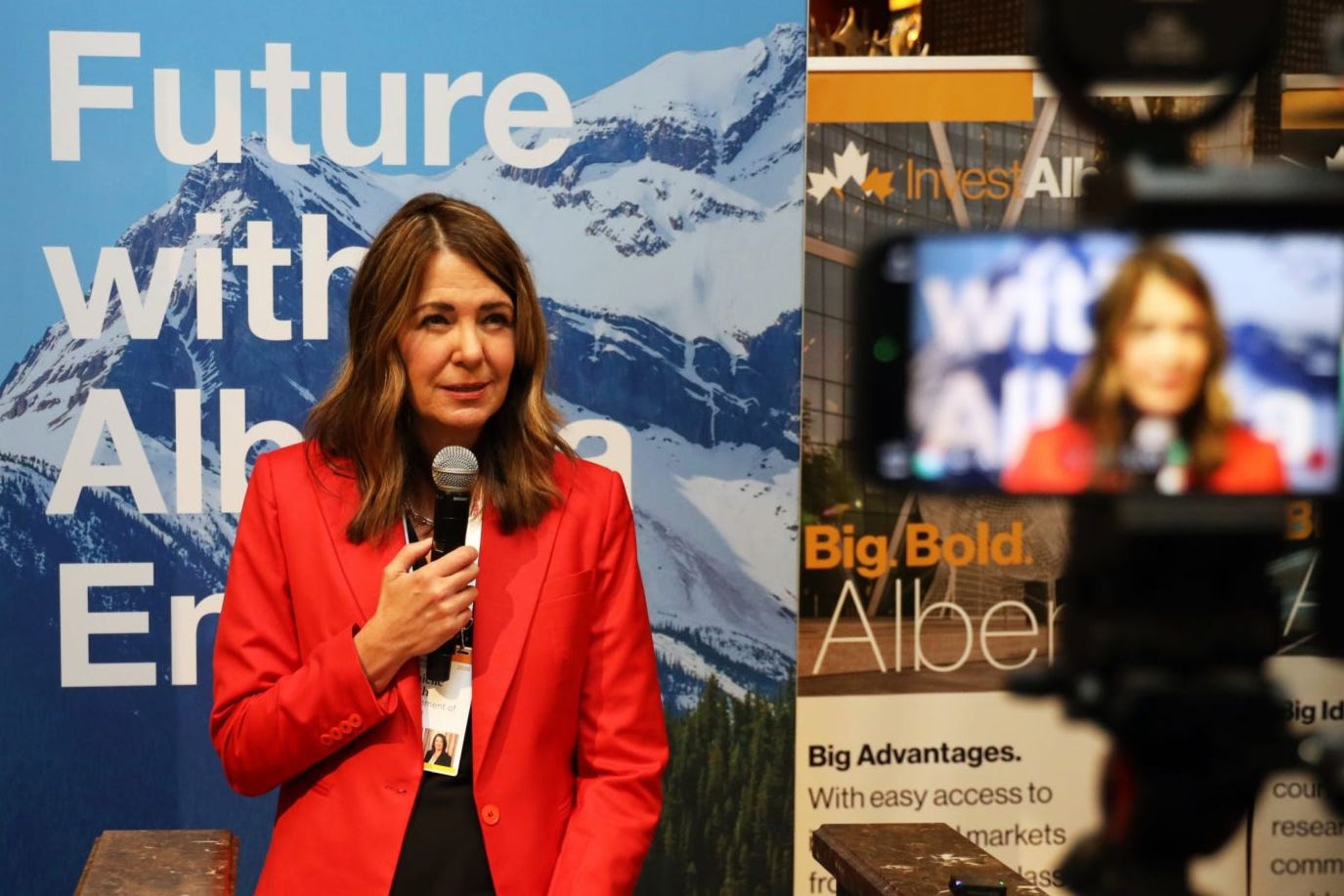
Alberta Premier Danielle Smith reflected on the current oil price spike, writing that “we must build new pipelines west, east, north and south — without delay and without hesitation — to supply Asian, European and American markets with safe, reliable and responsibly produced energy products.”
In an energy conference this past month, Smith previewed her government’s push to secure Pacific investors for a newly-proposed oil pipeline through British Columbia that would target Asian markets, promising to submit her planned one million barrel per day pipeline to Ottawa this June.
Referring to LNG Canada’s consortium as a model, Smith stated that foreign investors would represent “probably not a majority stake, but at least a substantial stake — maybe 15 or 30%… whether it’s Asian company partners, Middle Eastern partners, Canadian companies, or American companies.”
What commentators are saying — Experts have described how the global energy shock is changing the value and investment proposition of Canadian oil and gas:
Trans Mountain CEO Mark Maki observed that “everything that’s happening right now puts a big exclamation point on what the longer-term plans for Trans Mountain are… the West Coast will be really important to the country and some of our trading partners in Asia.”
Rory Johnston, lecturer at the Munk School of Global Affairs and Public Policy, estimated that “you could definitely have additional structural Asian demand come out of this, given the obvious kind of realized risk… when you have energy and security [fears] spike globally, brand Canada outperforms.”
Susan Bell, Rynstad Energy Vice President for Downstream Research, projected that “if it gets to the point where Asia truly is pinched on crude oil supply, then I would really expect to see Trans Mountain pipeline spot capacity fill up and that pull into the Asian market.”
Michal Meidan, Head of China Energy Research at the Oxford Institute for Energy Studies, noted that Beijing’s latest Five-Year Plan doubles down on longstanding energy security priorities, highlighting “import diversification and substitution to the extent possible and stockpiling.”
From the Experts
IPD brings what scholars and opinion leaders in China and Canada have to say on the challenges both countries face.
The Word in Canada

Wenran Jiang
Advisor, Institute for Peace & Diplomacy | READ
The U.S. is not the focused, relentless pursuer of containment it aspired to be. It is an overstretched power. The war in the Middle East is not a distraction from the China challenge; it is the embodiment of the strategic overextension that makes a coherent China policy impossible.
China, by contrast, exercises strategic patience. It sits on its mountain, watches the tigers below exhaust themselves, and secures for itself the one commodity geopolitics most prizes: time. Trump’s journey to Beijing will be a negotiation, but its very occurrence is a testament to the shift in strategic initiative – forged not in the Pacific, but in the burning sands where America is once again fighting all the tigers at once.

Paul Evans
Professor Emeritus, University of British Columbia | READ
For Canada, the costs of simultaneous economic conflict with its two largest trading partners would be devastating. There is a clear tactical advantage for Beijing to strengthen its ties with middle powers like Canada at a time when their relationships with its great power rival are under deep strain.
On the Chinese side, the durability of the new Strategic Partnership will also depend in large part on whether the door is opened wide enough for investment opportunities in Canada and on how far expanded partnerships reduce the scope of national security criteria being applied against them…
The improvement in the relationship between Carney and Xi was driven by geopolitics and the fear and uncertainty generated by a faltering yet powerful third party, namely the United States. The Canada-China breakthrough may have made things easier for other middle powers, like the U.K. and Germany, who have also stepped up their links with China recently.
The Word in China

Zhang Weiwei
Director, China Institute, Fudan University | READ
Overall, Carney’s [Davos] speech appeared calm, rational, and with some degree of controlled emotional appeal, winning much applause at the Davos Forum and also raising his domestic support in Canada. But whether he can truly forge a “third way,” I think it won’t be easy.
An important reason is that the middle powers he speaks of still refer to Western countries; at heart, he still wants to defend the so-called common interests of Western countries. He stated that Canada should pursue strategic autonomy and reduce dependence on the U.S., but on core security issues like the Middle East, Iran, and Israel, he is still unwilling to completely break away from the American camp.
What’s next below the paywall:
Further data on oil and gas markets, as well as the road ahead for Canada-China commodity trade
Younes Zangiabadi: Executive Director, Institute for Peace & Diplomacy
Fan Yongpeng: Vice Director, China Institute, Fudan University
See more data and commentary below the paywall by subscribing now for just $5 a month.
Thanks for reading the Canada-China Brief from the Institute for Peace & Diplomacy! Join a free trial now for full access to Data Dive and The Word in China coverage below, including extended analysis and translated expert commentary