

This week’s Canada-China Brief offers exclusive insight into major developments shaping the bilateral relationship:
Gaining traction: Understand what’s happening under the hood of Ottawa’s efforts to attract investment through new trade missions to China
Data Dive: See the key numbers, charts, and analysis behind new polling of Chinese perceptions of Canada
Expert voices: New analysis from experts in both Canada and China sheds light on a full view of world events and their impact on bilateral relations
Data Dive
The takeaways:
Trust in Canada among respondents of the 2026 Chinese Citizens’ Global Perception Survey remains relatively low at 30%, comparable to Australia and the UK, above the U.S. and Japan, but well below Russia.
Yet, support for Canada-China cooperation continues to grow, particularly in economic cooperation, rising from 66% in 2023 to 77% this year, second only to cultural exchange (80%).
In comparative terms, enthusiasm for economic engagement with Canada is average. Willingness to cooperate with Canada, both overall and specifically in technology, trails other Western countries such as Germany, France, and the UK.
What’s next below the paywall:
Chinese auto export data showing its quickening global growth over the past five years for electric and internal combustion vehicles
IPD highlights the numbers that matter. Access more data analysis below the paywall by subscribing now for just $5/month.
Top Story
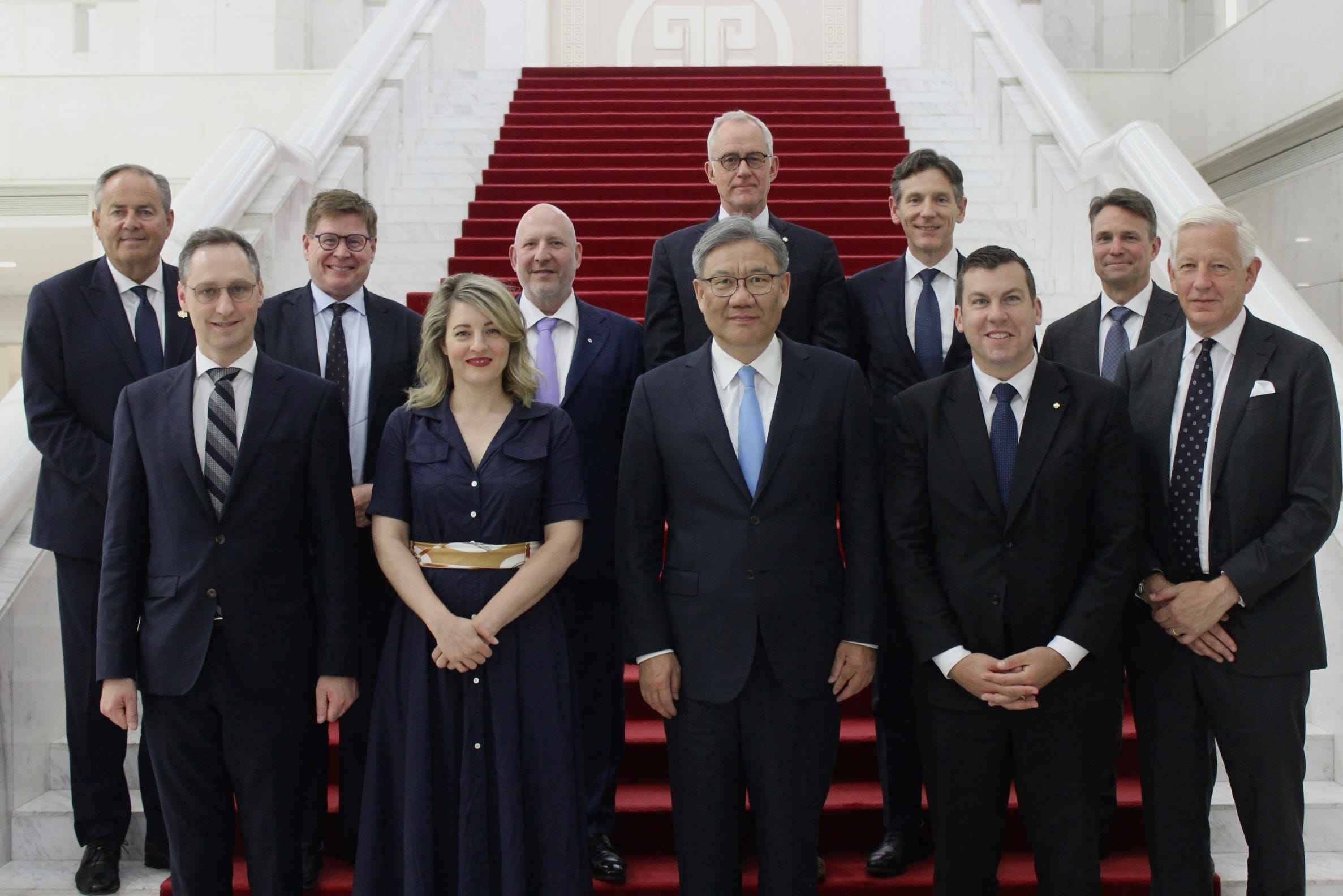
In China, Joly Sets Investment Conditions as CUSMA Stalls Over U.S. Concerns
Yellow light — Touring Beijing and Shanghai last month, Industry Minister Mélanie Joly held talks with China’s auto giants and reiterated conditions for market entry:
Joly met with Vice President Han Zheng, Commerce Minister Wang Wentao, and her counterpart Li Lecheng, stating that “Canada is ready to work with China to expand cooperation in emerging areas such as electric vehicles, batteries, and wind power [and] deepen cooperation in traditional sectors such as oil and gas.”
Visiting executives from Chery, BYD, Geely, and Shanghai Launch, she emphasized that proposals must include Canadian-majority joint ventures, compliance with labour standards, localized supply chains, and safeguards for software and data security, stressing that “there’s no other way.”
Joly told the Financial Times that all four were “willing to explore creating joint ventures,” with her criteria intended to encourage Canadian production while offering “great vehicles to Canadians that are affordable and with the latest technology” and protecting domestic manufacturing.
The mission comes as Beijing introduced a 73.5% anti-dumping tariff on Canadian pea starch at the end of June, concluding a probe by the Ministry of Commerce that began last August, and following Ottawa’s launch of an anti-dumping investigation in April against Chinese steel products.
Washington’s stop sign — U.S. negotiators have sent the North American free trade agreement back to the drawing board, citing China along the way:
American officials on July 1st formally declined to renew the CUSMA pact on the basis of trade deficits and other disputes, giving way to new talks as U.S. Trade Representative Jamieson Greer also took the opportunity to criticize the entry of Chinese investment into Canada.
Speaking to Global News, Greer drew a red line and said that “what I don’t want is a situation where Canada is bringing in a lot of Chinese investment and Chinese cars and sending them into America. That is actually totally at odds with what we’re trying to do.”
In a separate interview with Bloomberg, Greer proclaimed that “Canada is interesting because one day they’ll say, ‘we want to help America reindustrialize. We want to help make America great again,’ then the next day they’ll talk about bringing in Chinese investment. So we get mixed messages from Canada.”
BC in Beijing — After Joly’s trip, British Columbia Premier David Eby also undertook his first official visit in an effort to secure investment for LNG Canada’s expansion:
Meeting in Beijing with executives from PetroChina, which holds a 15% stake in the LNG Canada project, the Premier stated that the company was the “really big fish” on his agenda as he worked to persuade it to support the final investment decision for the second phase expansion expected this September.
The Premier said that a successful investment would be “worth about $28 billion in terms of provincial revenue to pay for public services. And so meeting with them, identifying any final concerns as they reach final investment decision is another example of concrete things that we’re seeking to achieve here.”
Meanwhile, Chinese Ambassador to Canada Wang Di recently told Reuters that bilateral trade could triple if economic and diplomatic momentum could be sustained, stating that “maybe we can go beyond the 100% growth target and even reach 200%.
What commentators are saying — Joly’s investment push has sparked debate over Chinese automakers’ interests in Canada’s market and their implications for CUSMA:
Farid Ahmad, head of Dealer Solutions and Mergers and Acquisitions, said Chinese car companies “are positioning themselves so that whenever the political landscape changes… they’ll be ready to provide vehicles in [the U.S.] market as well. They’re knocking at the gate.”
The U.S. Alliance for Automotive Innovation warned that Ottawa could “create a potential backdoor for Chinese brands to enter the U.S. market,” stressing that “market distortions and risks to the auto industry in the U.S. are fundamentally the same whether these vehicles are imported or produced domestically.”
Christopher Worwick, Professor at Carleton University, floated that the Canadian auto industry may have to “phase out” if CUSMA negotiations fail to provide relief, noting that joint ventures and “forcing Canadians to pay extra for Chinese EVs so as to protect jobs in a relatively small industry is questionable at best.”
Diego Marroquin Bitar, Fellow at the Centre for Strategic and International Studies, said “it doesn’t make sense to build a fortress North America against non-market economies if the partners in that fortress don’t have full access to the U.S. market,” suggesting “let’s find consensus as to which investments we want.”
From the Experts
IPD brings what scholars and opinion leaders in China and Canada have to say on the challenges both countries face.
The Word in Canada

Kristen Hopewell
Director, Liu Institute for Global Issues and Canada Research Chair in Global Policy, School of Public Policy and Global Affairs, University of British Columbia | WATCH
You have major powers in the system blatantly violating the rules. The U.S. has disabled the WTO Appellate Body, which is critical for enforcing global trade rules. We’ve seen the spread of protectionism worldwide, and of course the WTO’s negotiation function has also largely broken down.
In this context, increasingly states are scrambling to try to find alternative ways to try to continue to foster international cooperation on trade, to try to maintain a relatively free and open global economy, to try to continue global economic integration, and increasingly are turning to alternative mechanisms beyond the multilateral trading system. […]
Plurilateral, bilateral, regional agreements represent an important means to do that. At the same time, there are also limitations to these agreements as well. This is very much a second-best alternative to truly global multilateral trade deals.

Steven Globerman
Addington Chair in Measurement and Senior Fellow, Fraser Institute | READ
The primary challenge for Canadian businesses hoping to sell more to China is the costs associated with managing significant differences in laws, regulations, business practices, cultural norms and language between the two countries. Canadian exporters can mitigate these costs by establishing closer supply chain linkages with Chinese commercial partners. It follows that increasing Canadian exports to China will require Canadian companies to become more integrated into China’s dominant supply chains. [...]
[T]o achieve this goal [of increasing non-U.S. exports], Canada must establish itself as a reliable long-term exporter to China. And that’s likely to raise the ire of the current U.S. president and perhaps future presidents. With trade diversification top of mind, Prime Minister Carney and his negotiators face a complex balancing act in managing relations with our closest ally and main trading partner on the one hand, and the world’s leading manufacturing country and steadily rising global power on the other.

Paul Samson
President, Centre for International Governance Innovation | READ
The United States, the global cop who backstopped the international system for many decades, has flipped the script and is now utterly consumed by an inward focus that is likely to persist in one form or another. Despite China proposing new principles for global governance, no country or coalition is willing or able to shape a new order—at least not yet. The result is a low-trust world, where international rules are weak, unclear, or simply overridden by great-power dynamics.
Canadians are under no illusions about what is at stake economically, politically, and philosophically. The second Trump administration’s early decision to impose punitive tariffs on Canada showed a total disregard for North America’s oldest and deepest partnership, as well as for the trade agreement that Trump himself signed during his first presidency.
Since the tariffs came at a time when Canada’s relations with the European Union, China, India, and other emerging economies had weakened, they served as a wake-up call. Canada would need a new national vision and strategy that was not all-in on US integration. It would need to diversify its trade and hedge its foreign-policy commitments.
The Word in China

Zhou Mi
Deputy Director and Senior Fellow, Institute of the Americas and Oceania, Chinese Academy of International Trade and Economic Cooperation | READ
Forcing a link between USMCA renewal and normal Chinese economic cooperation with Canada and Mexico is baseless and labelling legitimate commercial ties as 'backdoor' disregards Canada's right to make its own foreign and economic policy.
The U.S. wants a yearly review — not a multi‑year cycle — so it can constantly pressure others to reshape their policies to favour American interests. This is not constructive change; it forces partners to sacrifice their own gains for U.S. advantages. Such an approach undermines long‑term business confidence and creates instability in supply chains in the North American market.
The U.S. is overreaching by trying to dictate what Canadian companies buy or invest in, and if American products cannot compete, blocking Canadian purchases from China defies basic market logic and harms the normal functioning of international commerce.
Given China's status as the top supplier of parts, components and intermediate inputs, as well as the deep industrial integration formed over decades, efforts to exclude Chinese inputs are neither realistic nor economically viable. Such efforts will undermine the competitiveness of North American manufacturers.

Peng Wensheng
Chief Economist, China International Capital Corporation | READ
For small and medium-sized economies, going it alone is clearly a passive strategy. Canadian Prime Minister Mark Carney’s call for medium-sized nations to unite against U.S. hegemony is a case in point. Additionally, smaller countries can participate in division-of-labour systems centred around major powers such as China’s Belt and Road Initiative or focus on niche sectors to achieve economies of scale, as seen with TSMC or the Swiss financial industry. However, under the new landscape of geoeconomic competition, even these models face challenges: TSMC has been pressed by the U.S. to relocate away from Taiwan, and Switzerland’s credibility as a neutral state has been undermined by the Russia-Ukraine conflict.
See more in translation under the paywall.
What’s next below the paywall:
Data tracking the growth trajectory of China’s overseas auto exports over the past half-decade
He Weiwen: Senior Fellow, Chinese Association of International Trade
Liu Dan: Research Fellow, Center for Regional and Country Studies, Guangdong University of Foreign Studies
Peng Wensheng: Chief Economist, China International Capital Corporation
See more data and commentary below the paywall by subscribing now for just $5/month.
Thanks for reading the Canada-China Brief from the Institute for Peace & Diplomacy! Join a free trial now for full access to Data Dive and The Word in China coverage below, including extended analysis and translated expert commentary