

This week’s Canada-China Brief offers exclusive insight:
Paving the way to Beijing: Review the latest as Anita Anand and Wang Yi build momentum for the Prime Minister’s visit to China next year
Data Dive: Key numbers, charts, and analysis on changing public sentiment towards prioritizing economic ties with Beijing
Expert voices: New analysis from experts in both Canada and China sheds light on a full view of world events
Subscribe for just $5/month or $50/year to access full analysis, stay ahead of the curve on Canada-China relations, and support independent, policy-driven coverage.
Top Story
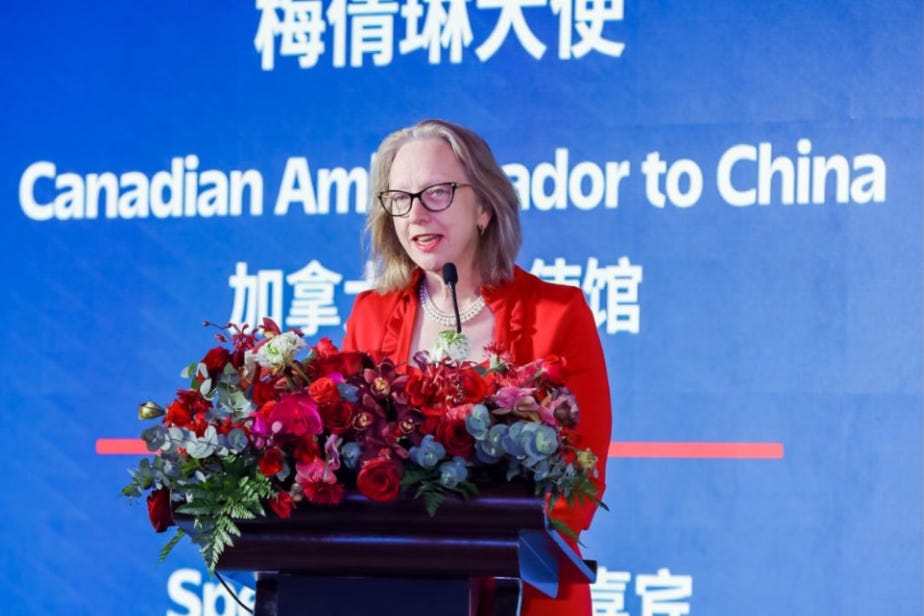
May Calls Relationship ‘One of Our Most Consequential’ as Ministers Continue Talks
Trading calls — Foreign Minister Anita Anand has followed up on Prime Minister Carney’s meeting with Xi Jinping with a call last month to counterpart Wang Yi:
In China’s readout, Foreign Minister Wang noted that “implementing the common understandings reached by the leaders of the two countries is currently the most important agenda for China-Canada relations” as Anand indicated Ottawa was “willing to seize this opportunity to strengthen dialogue.”
Days before the call, Anand welcomed Beijing re-assigning ‘Approved Destination Status’ to Canada for Chinese group travellers, a major administrative lever that had previously been withdrawn and stifled Chinese tourism operations in Canada for years.
Agriculture Minister Heath MacDonald shared in an interview that his talks on EVs, canola, and tariffs with counterparts in his recent visit to Beijing were constructive, adding “it’s not 2018 anymore, it’s 2025. We’re a new government… They’re a great trading partner. We need them and we think they need us.”
In an op-ed, Ambassador to Canada Wang Di said the Carney-Xi meeting “charted a blueprint,” and that both should “jointly safeguard the political foundation of bilateral relations” as “the world today is undergoing profound and complex changes, with unilateralism seriously eroding the existing international system.”
Commenting on current talks, Saskatchewan Premier Scott Moe stated that “there is a path for us to negotiate our way forward… what is the return policy from China when it comes to not only canola, but pork and seafood as well? Those discussions, I’m quite confident, are actually happening as we speak.”
‘Opportunity within uncertainty’ — Rhetoric from both countries’ top diplomatic representatives has slowly indicated an upward trajectory:
The Canadian Embassy in Beijing co-hosted a function celebrating bilateral ties last week with the Chinese People’s Association for Friendship with Foreign Countries, with Ambassador Jennifer May sharing that work continues “at a rapid pace” to advance Carney’s talks with Xi and prepare his visit to China next year.
May stated that she observed “a period of profound global upheaval, an era shaped by shifting geopolitics and economic volatility,” but that “within this uncertainty, there is also opportunity. That is why [the] Prime Minister has committed to doubling Canada’s non-U.S. exports over the next decade.”
Calling China “one of our most consequential trading relationships,” May went on to say that “we look to address trade challenges and advance cooperation to shape a forward-looking economic relationship… we are here to build this relationship and to build it strong.”
In a Canadian media interview, Ambassador Wang noted that the ongoing tariff dispute “does not represent the whole relationship between China and Canada” as Carney and Xi “talked about how to lift our strategic partnership to a higher level, and that will be a wider framework for both sides to discuss many issues.”
What commentators are saying — Experts across the spectrum have echoed acknowledgement of a change in tone in the relationship as momentum picks up:
Reza Hasmath, Professor at the University of Alberta, argued that “our current approach often uncritically mirrors Washington’s moves, and this is no longer viable,” observing that “Canada has avoided a comprehensive China strategy because any coherent approach requires difficult trade-offs.”
Executive Director Kyle Larkin of Grain Growers of Canada recounted in a Senate foreign relations committee that in D.C., “all of the members of Congress we spoke to, Republican and Democrat, did not know that Canada had taken tariffs against Chinese electric vehicles at the behest of the American administration.”
Zheng Xiaoling, President of the Canada International Trade Promotion Society, underscored the recent reopening of tourism pathways, saying that its “significance goes far beyond tourism itself. This is a positive and symbolic decision, showing that China is willing to resume exchanges and cooperation.”
Former diplomat and Canadian Global Affairs Institute Fellow Colin Robertson suggested that “the goal must be coexistence—combining competition with cooperation while sustaining the people-to-people ties that outlast political cycles” as part of “a strategy rooted in what might be called functional realism.”
Greg Chin, Associate Professor at York University and former First Secretary at the Canadian Embassy in Beijing, noted that trade linkages are difficult to substitute, saying that “if it was so easy for our canola farmers to pivot to other markets, we would have done it.”
From the Experts
IPD brings what scholars and opinion leaders in China and Canada have to say on the challenges both countries face.
The Word in Canada

Jocelyn Coulon
Advisor, Institute for Peace & Diplomacy; Former Senior Advisor to the Minister of Foreign Affairs | READ
If Canada has little means to engage diplomatically and militarily in the great game underway in Asia, Mark Carney at least has the opportunity to go there to deepen current relations. He has a precise and well-calibrated roadmap with Canada’s Indo-Pacific Strategy, adopted almost three years ago. Two observations emerge that should encourage us to turn our gaze and our energies to this region: in five years, it will be home to two-thirds of the world’s middle class, and in 2040, it will represent more than half of the world economy…
The government’s voluntarism alone will not be enough to loosen the grip of the United States on our daily lives. None of the prime minister’s foreign visits will amount to anything if economic and political actors — long too comfortable in a dependent relationship with the United States — do not contribute by making full use of the opportunities offered by the dozens of free-trade agreements Canada has signed in recent years. Here, the entire social, economic, and cultural mindset will need to change going forward.
The Word in China

Zhao Minghao
Professor and Deputy Director, Center for American Studies, Fudan University | READ
The Trump administration has sought to transform the Western Hemisphere into an “economic fortress” for the United States. During Trump’s second term, U.S. economic diplomacy shifted its focus toward reshaping hemispheric economic relations…
Trump has sought to rebuild U.S. manufacturing capacity and secure America’s long-term development by relocating supply chains to the Western Hemisphere and reducing dependence on external competitors. To lower dependence on China, the United States attempted to shift global supply-chain links toward the Americas, creating a U.S.-centered hemispheric economic system.
Under this framework, the Western Hemisphere has been treated as America’s sphere of influence, with economic security placed above all else. The Biden administration had previously emphasized friend-shoring, redirecting critical supply-chain components to friendly countries. Trump expanded this approach, promoting broader supply-chain relocation throughout the hemisphere to absorb regional growth and strengthen U.S. economic security.
What’s next below the paywall:
Ding Gang: Senior Fellow, Chongyang Institute for Financial Studies, Renmin University
See more Chinese commentary below the paywall by subscribing now for just $5 a month.
Data Dive
The takeaways:
New polling indicates public sentiment prioritizing economic relations with China have inverted since 2023
51% of Canadians in 2025 now agree with focusing on economic ties with China, flipping from 50% in 2023 that did not agree
44% of polled Canadians believe Canada is missing out from economic opportunities in China
What’s next below the paywall:
Data on how the U.S. imports from China and Canada have fallen over the past year as tariffs have taken their toll
IPD highlights the numbers that matter. See more data analysis below the paywall by subscribing now for just $5 a month.
Thanks for reading the Canada-China Brief from the Institute for Peace & Diplomacy! Join a free trial now for full access to Data Dive and The Word in China coverage below, including extended data analysis and translated expert commentary